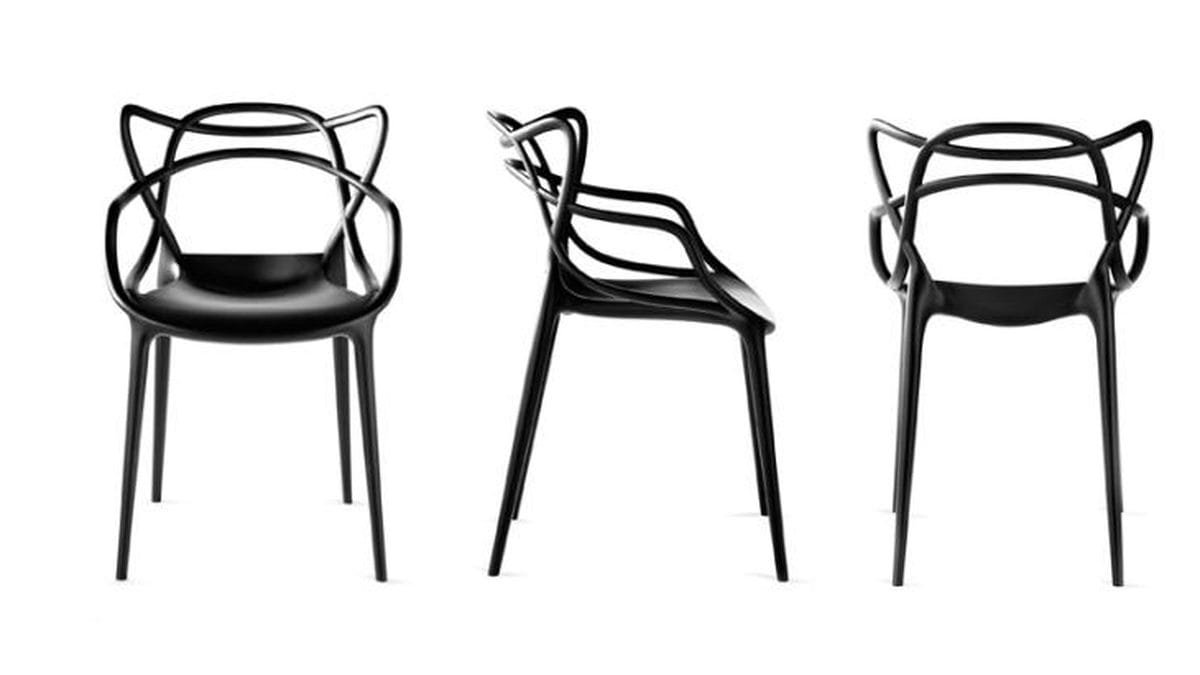

HAY is a Danish furniture and design brand founded in Copenhagen in 2002 by Rolf and Mette Hay. It sells contemporary furniture, lighting and accessories by designers such as Ronan and Erwan Bouroullec, Inga Sempé and Hee Welling, whose About A Chair is its best-known piece, at mid-range prices. Herman Miller bought a 33% stake in 2018 and took majority ownership in 2019, so HAY now sits within MillerKnoll and is sold in the US through Design Within Reach.
The HAY Danish design brand argued that Scandinavian furniture had become expensive and museum-facing, and corrected that with contemporary collaborations, accessible prices, and products that treat color as a design position, not a finishing option.
What the HAY Danish design brand was arguing when Scandinavian furniture became a museum artifact
By 2002, Danish furniture’s golden era had calcified. The Jacobsen chairs that once felt forward-looking were ending up in airport lounges and hotel lobbies, heritage objects performing prestige rather than solving spatial problems. Wegner’s chairs lived in galleries. The designers who made them were dead. The brands that held their rights were selling reproductions and nostalgia.
Rolf and Mette Hay met at Gubi, the Copenhagen design house, and identified exactly this gap. The contemporary designers working in Denmark and across Europe had no platform at accessible price points. The established Scandinavian brands had turned their catalogs into museums. HAY’s founding argument, backed by investor Troels Holch Povlsen, was that this was correctable. Working with living designers from around the world, at prices that did not require a gallery budget, was both commercially viable and design-honest.
The first HAY collection debuted at imm Cologne in January 2003. The first store opened in 2004 on Pilestræde in central Copenhagen, deliberately positioned as a contemporary retail experience, not a heritage showroom. Rolf took responsibility for furniture and lighting; Mette focused on accessories. The division of labor was practical and the result showed: HAY built a coherent aesthetic across scales, from a small tray to a sectional sofa. For the longer history of the tradition HAY was departing from, see Scandinavian Design History.
HAY’s commercial success attracted institutional attention. Herman Miller acquired a 33% stake in June 2018 for $66 million, then increased to majority ownership in October 2019. HAY now operates under the MillerKnoll umbrella but maintains its own design identity and its own roster of collaborators. The acquisition is evidence of market validation, not a design inflection point. The brand’s position has not shifted.
The brand draws from three sources that Rolf Hay has cited directly: art, architecture, and fashion. These are structural influences, not references. They explain why a HAY object reads with a different weight than a generic Scandinavian product pulling from the same formal vocabulary.
Why HAY’s price point is not a compromise: it is the argument
HAY’s collaborators include Ronan and Erwan Bouroullec, Doshi Levien, and Inga Sempé, designers whose work appears in gallery collections and museum shops. The fact that their contributions to HAY exist at accessible price points is not a dilution of their practice. It is the brand’s thesis made concrete.
The About A Chair (the AAC series, designed by Hee Welling) is HAY’s most commercially significant furniture piece. A molded polypropylene seat shell on powder-coated steel or wooden legs, available with or without armrests, in multiple seat options, suitable for dining, office, or cafe use. The modularity is real modularity, not marketing modularity. The same structural logic works in a Copenhagen restaurant and a home dining room without looking compromised in either context.
HAY has pieces in the MoMA permanent collection. That placement answers a question that accessible pricing often raises: does a lower price correspond to lower design intelligence? In HAY’s case, it does not. The Colour Crate, for instance, is made from 100% recycled post-consumer plastic and has been copied more than almost any other HAY product. The copies exist because the original works. HAY’s own account of the Colour Crate’s material reasoning — recycled polypropylene chosen for function, not as a sustainability gesture — is documented in the brand’s product notes at hay.com.
Rolf Hay has cited Charles and Ray Eames (their curiosity and playfulness, their refusal to treat accessible pricing as a concession) alongside Bauhaus principles as the intellectual anchors for his practice. These are not accidental references. The Eameses made plywood furniture for the American middle class and put it in MoMA. HAY is doing the same thing in a different material and a different decade. The Design Museum London has described HAY’s approach to the designer-producer relationship as one of the clearer examples of the contemporary design collaboration model — the brand as platform rather than studio.
HAY products that prove the argument
About A Chair (AAC) by Hee Welling, 2010. Molded polypropylene seat shell, powder-coated steel or solid wood legs. Designed so the same structural logic works at a dining table, in an office, or stacked in a cafe. This is not a chair designed to look versatile: it is a chair whose geometry actually resolves the competing demands of those three contexts without aesthetic compromise.
Colour Crate (introduced c. 2014, updated to recycled polypropylene). Stackable, foldable storage container available in an aggressive range of colors: icy pastels, Memphis-adjacent primaries, saturated neutrals. Made from 100% recycled post-consumer plastic waste. The closest HAY gets to a manifesto object: the material is responsible, the color is a position, and the function is solved completely. The fact that it has been copied more than almost any other HAY product is a reliable indicator that the original is correct.
Mags Sofa (HAY, 2012). Modular sectional system that can be configured from a loveseat to a sprawling sectional arrangement. HAY’s strategy of bringing modular furniture logic, previously reserved for high-end brands, to a wider market. The execution is clean: the modules connect predictably, the proportions work at different scales.
Copenhague Table (CPH series) by Ronan and Erwan Bouroullec. Solid linoleum top, wooden legs. A direct collaboration with two of the most respected designers working in France, at a price point that puts the Bouroullec name in actual dining rooms rather than in design-press photographs. The linoleum surface ages well and is quieter in a room than lacquer.
AAC 100 series by Hee Welling. Higher backrest, lower seat variant of the original AAC. The detail that shows how HAY iterates: rather than replacing a successful form, they refined it for comfort within the same design language. The 100 series offers support for longer sitting without changing what the chair looks like.
Shop the Collection
HAY furniture (chairs, sofas, tables) is sold in the US primarily through Design Within Reach, where the old us.hay.com store now redirects, and through specialty retailers. The products with reliable Amazon availability are accessories and storage, where HAY’s argument about color and material is most directly legible anyway. For a full guide to HAY’s best products, see Best HAY Products.
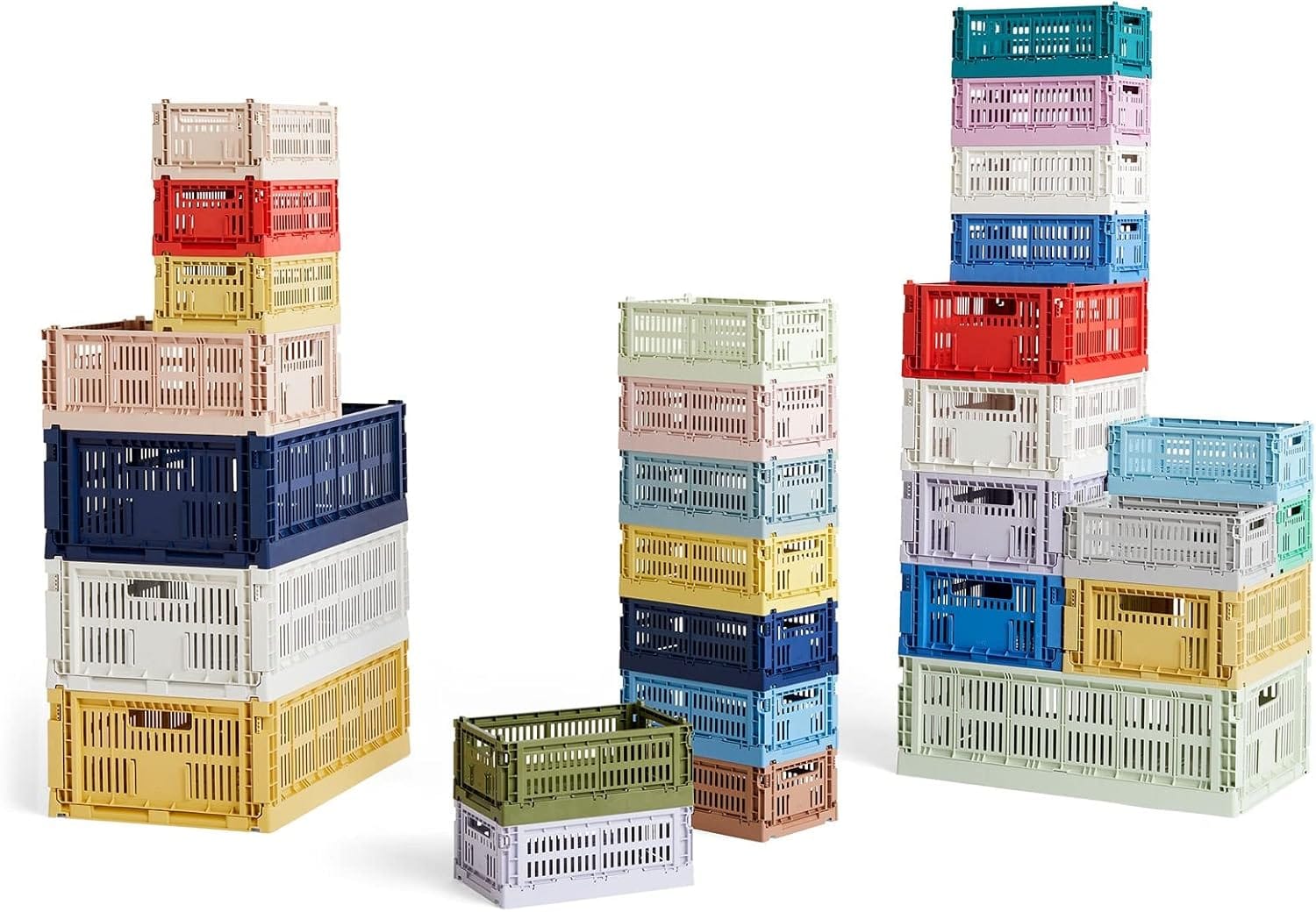
- HAY Colour Crate S (Dark Mint): The small crate in dark mint is where HAY’s color argument reads most clearly: stackable, foldable, made from recycled polypropylene, and the right size for a desk or kitchen shelf; storage that does not try to disappear.
- HAY Colour Crate M (Red): The M size is the practical workhorse, large enough for A4 documents, kitchen staples, or studio supplies; the red colorway is the most direct statement of HAY’s position on color as a design decision rather than a finishing option.
- HAY Colour Crate S (Dark Blue): For interiors that run quieter, dark blue against white shelving is how HAY products look in their own Copenhagen store; same recycled-polypropylene construction, same functional argument, different register.
Further Reading
Two books explain what HAY is doing and where it comes from. One is about HAY; one is about what HAY was correcting.
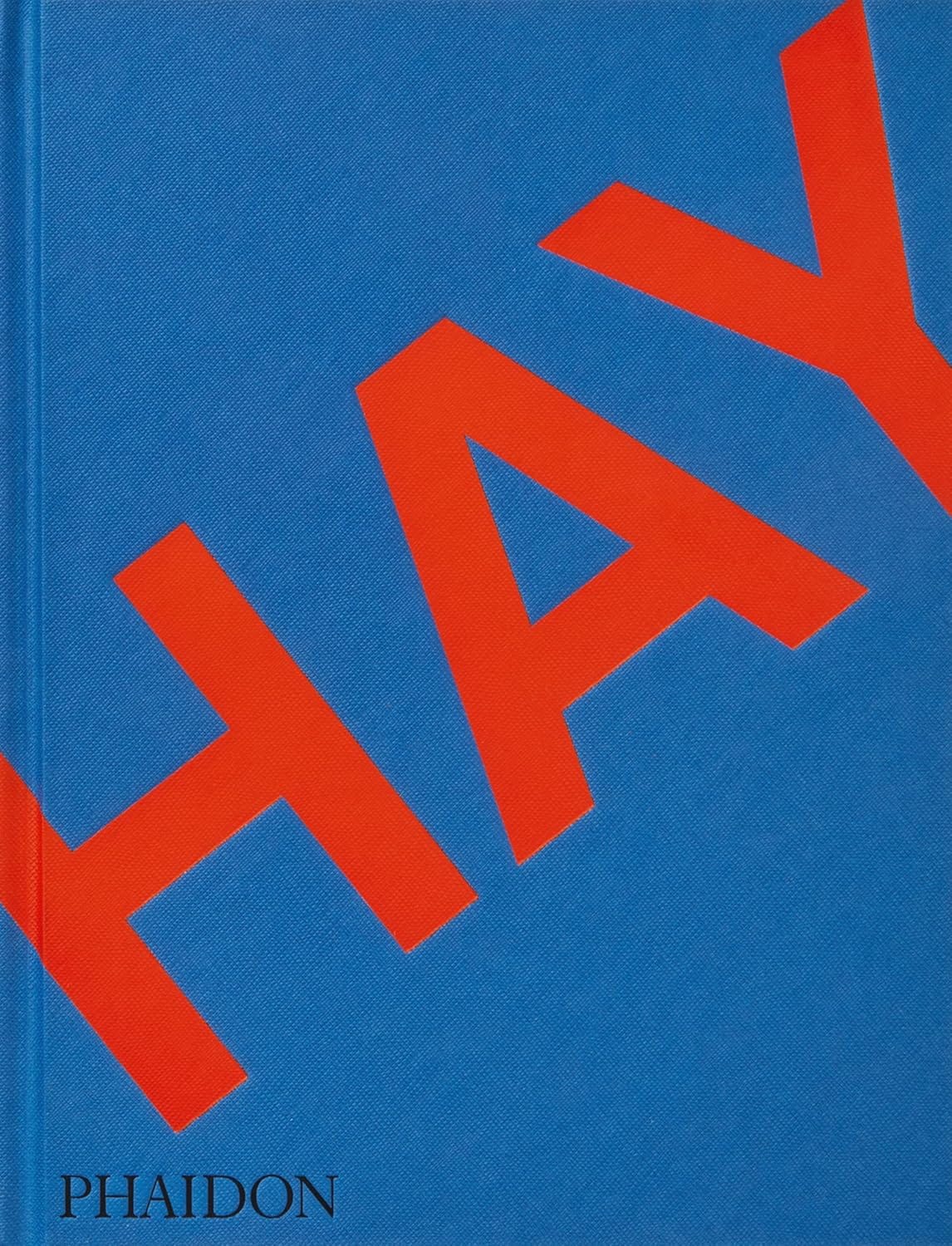
- Kelsey Keith, Rolf and Mette Hay, HAY (Phaidon, 2022): The official 20th-anniversary monograph: 600 color images and the brand’s own account of its founding argument; this is not a brand book dressed up as a design document, it is a genuine record of what HAY has built and why.
- Charlotte and Peter Fiell, Scandinavian Design (Taschen, Bibliotheca Universalis): The full historical context for what HAY was responding to: the golden-era designers HAY acknowledged and then chose to move beyond; reading it alongside the HAY monograph makes the correction legible.
Frequently Asked Questions
What is HAY furniture known for?
HAY furniture is known for contemporary Scandinavian design at accessible price points, strong collaborations with international designers, and a distinctive approach to color, particularly in its accessories line. The About A Chair (AAC series) is HAY’s most commercially recognized furniture piece. HAY products are also notable for material responsibility; the Colour Crate is made from 100% recycled post-consumer plastic.
Where can I buy HAY products in the US?
HAY arrived in the United States in 2015 through the MoMA design store. In the US, HAY furniture and accessories are sold through Design Within Reach (the primary US dealer, and the destination of the former us.hay.com store) and select specialty retailers. HAY accessories (including the Colour Crate) are available on Amazon with reliable stock. Furniture availability on Amazon is inconsistent; Design Within Reach is the more reliable option.
Is HAY furniture good quality?
Yes, for a mid-range brand. HAY furniture quality is generally strong, particularly in the Colour Crate accessories and Palissade outdoor furniture line, both of which have received consistently positive reviews. Textile quality reviews are more mixed. The brand’s price positioning is mid-range (not cheap, not luxury) and the quality reflects that bracket accurately.
Is HAY owned by Herman Miller?
Yes, majority-owned. Herman Miller bought a 33% stake in HAY in June 2018 for $66 million and raised it to majority ownership in October 2019. After Herman Miller acquired Knoll in 2021 the parent company became MillerKnoll, which also owns Design Within Reach. Rolf and Mette Hay remain HAY’s creative directors, and the brand keeps its own name, catalog and designers.
Where is HAY furniture manufactured?
Mostly in Europe. HAY designs its products in Copenhagen and has them made by selected partner manufacturers, and most of that production takes place in Europe. Most of its wooden products use FSC-certified wood. After Herman Miller’s 2018 investment, the two companies also worked to localize production for the North American market. Check the product listing if country of origin matters for a specific piece.
What makes HAY furniture unique?
Its mix of named designers, strong color and mid-range prices. HAY works with international designers such as Ronan and Erwan Bouroullec, Inga Sempé, Stefan Diez and Hee Welling rather than reissuing mid-century classics, and it treats color as part of the design. Several HAY pieces, including Louise Campbell’s Prince Chair and Stefan Diez’s Rope Trick lamp, are in MoMA’s collection.
Who founded HAY and when?
HAY was founded in 2002 in Copenhagen by Mette and Rolf Hay. Rolf focuses on furniture and lighting; Mette focuses on accessories. The brand launched its first collection at imm Cologne in January 2003 and opened its first store in Copenhagen in 2004. The primary early investor was Danish entrepreneur Troels Holch Povlsen.
How does HAY compare to IKEA on design quality?
HAY occupies a different market position than IKEA. IKEA competes on volume and price minimization; HAY competes on design collaboration and material quality at a mid-range price point. HAY works with named international designers (Hee Welling, Ronan and Erwan Bouroullec, Inga Sempé) and its products are in MoMA’s permanent collection. The price difference between the two brands corresponds to a real difference in material and design investment.
Are HAY products available on Amazon?
Yes, selected HAY products are available on Amazon, primarily accessories and storage items. The Colour Crate line (HAY’s most copied and most design-legible accessory) has multiple verified listings on Amazon. HAY furniture (chairs, sofas, tables) is not consistently stocked on Amazon and is better purchased through Design Within Reach.
For a direct comparison with Vitra — the other major European design brand operating at a similar design-quality position — see Vitra vs HAY. For a comparison with Areaware’s Brooklyn-based approach to design objects, see Areaware vs HAY or the full Areaware brand profile. For practical guidance on using HAY pieces in a home interior, see how to decorate with HAY furniture. For the broader context of this work, see the Design Brands & Ateliers hub — a guide to the brands and studios driving contemporary design.

About Zoe Post
Zoe Post holds a BFA and a Master of Architecture from the School of the Art Institute of Chicago. She now works as a product marketing leader at an architectural product design firm, bringing hands-on industry perspective to everything she writes. At ADI she covers contemporary artists, textile and pattern design, and the design objects that sit at the boundary of art and function.