

If you want to buy Philippe Starck furniture on a budget, the options are better than you’d expect. The Kartell Ghost Chair sells new for around $400 and used from $155. Starck designed for mass accessibility — his Target collaboration put his work in supermarkets — and that principle extends to today’s secondhand market.
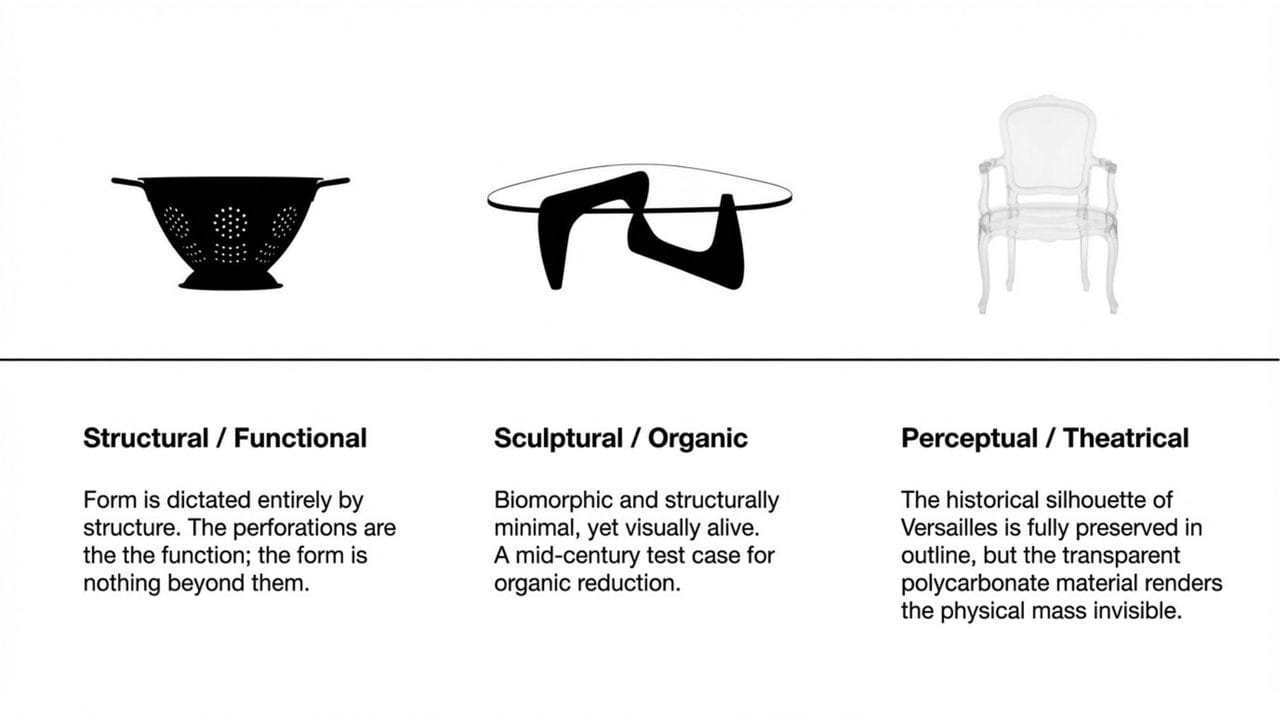
Starck built his career on the argument that good design should cost less
The democratic design argument is not marketing spin. It is Starck’s stated position since at least 1998, when he produced the “Good Goods” catalogue with La Redoute: 170 sustainable everyday objects described as being “for the future moral market.” This was not a commercial venture dressed up in idealism. It was Starck working out what he actually believed about who design was supposed to serve.
In April 2002, he launched “Starck Reality” at the Milan Furniture Fair: 50-plus everyday products across home, office, kitchen, bath, and baby categories, sold at Target. He put his name on magazine racks, tape dispensers, bathroom scales, baby monitors, and portable furniture. His stated goal was to reach the maximum number of people at affordable prices. That history is the lens for everything below, and for Starck’s full design arc, see our Philippe Starck profile.
How to buy Philippe Starck furniture on a budget: four price levels
The hierarchy runs from the Kartell line (new, authenticated, still in production) through the secondhand market, through the Target-era objects that most people overlook, to the small design objects that give you a genuine Starck piece for under $30. Each level has different sourcing logic.
Start with the Kartell line (new, $250–$650)
Kartell is the most accessible entry to authentic Starck design you can buy new. Three pieces are worth knowing.
The Louis Ghost Chair, designed around 2000, is the one most people know: transparent polycarbonate, a Louis XV silhouette stripped to its formal logic, stackable to six, weather-resistant enough for outdoor use. It retails at roughly $400–$415 per chair through authorized dealers, including Design Within Reach and Amazon. Over two million units have sold, which means it is not rare, which means buying new is entirely rational.
The Victoria Ghost Chair is the side-chair variant: a lighter silhouette, no armrests, suited to dining contexts where the Louis Ghost’s width becomes a problem. Retail runs $250–$300.
The Masters Chair, designed in 2010 with Eugeni Quitllet, is Starck at his most explicitly quotational. The back is a compression of three modernist chair backs: Jacobsen’s Series 7, Saarinen’s Tulip, and the Eames Eiffel. It won the 2010 Good Design Award and the 2013 Red Dot Design Award. It is made from modified batch-dyed polypropylene rather than polycarbonate, which puts it at a lower price point (roughly $280–$350). For context on where the Masters Chair sits in Starck’s broader output, see Top Philippe Starck Designs.
These pieces are mass-produced in Italy. They are not collectibles. There is no premium for rarity, because rarity does not apply.
Shop secondhand for original pieces at 40–60% off
The secondhand market for Kartell Ghost Chairs is active enough that you can afford to be selective. Chairish, 1stDibs, and eBay all carry authentic examples. Based on 1stDibs listing data, used Ghost Chairs average around $260 and start from $155, a genuine 40-plus percent reduction from new.
eBay yields the best prices but requires knowledge. eBay is also where counterfeits concentrate. Authentication markers on a genuine Kartell chair: an embossed mark on the seat, a date stamp, Kartell branding, and the designer’s signature. Counterfeits, most commonly made from acrylic rather than polycarbonate, lack the optical clarity of the real thing, yellow over time, scratch more easily, and are structurally inferior. If the price is $80 new, it is not Kartell.
Chairish is selective, screening for better-condition pieces. 1stDibs verifies condition but prices accordingly. Vintage dealers like furnishmevintage.com stock Starck pieces with some regularity. None of these platforms is a sure thing; all of them reward knowing what you are looking for.
The Target era pieces are underrated (and findable)
The 2002 “Starck Reality” collection for Target is the most underrated entry point in the entire secondhand market. These are not collectibles. Starck designed them to be the opposite of collectibles. They are genuine Starck design thinking at supermarket prices, and they turn up at thrift stores, eBay, and estate sales for very little.
What to look for: bathroom accessories, kitchen utensils, letter sorters. The line was wide and functional. None of it will appreciate in value. All of it is Starck’s democratic argument made physical, at the prices he was arguing for.
The framing that matters here: a Starck-designed soap dispenser from Target, bought at Goodwill for four dollars, is more authentically Starck in its origin and intention than a $3,000 “inspiration” Ghost Chair bought from an unlicensed manufacturer online. The design sensibility is present in the cheap object. It is absent from the expensive fake.
Books and small objects as budget entry points
For under $30, you can own a TASCHEN Starck monograph, the closest thing to having his complete design output documented in a form you can actually hold. These surveys cover the full arc from Café Costes to Kartell to Target, not just the showroom highlights.
The Juicy Salif juicer, designed for Alessi in 1987, has become a collectible. Used examples appear on eBay, and Alessi still sells new versions directly. It is not furniture, but it is an authentic Starck design object with a documented provenance and production history. For someone building a design-literate home on a budget, that distinction matters. A bookshelf with a Juicy Salif and a TASCHEN monograph is a considered design choice. A Ghost Chair counterfeit is not.
For Starck’s most significant works across all categories, see Top Philippe Starck Designs.
For a direct comparison of design philosophies, see Dieter Rams vs Philippe Starck — which places Starck’s approach alongside its most principled counterpoint.
When to spend more (and why)
Some Starck pieces do not have a budget equivalent. The Costes Chair, three-legged, designed for Café Costes in Paris in 1984, is one of the objects that announced his career. It now trades in the four figures at auction. No reproduction captures it. This is not because the design is too complicated to copy; it is because the object’s value is partly historical, and history cannot be reproduced.
The rule for premium spending: if a piece costs $800 or more new and the manufacturer is Kartell, Alessi, Emeco, FLOS, or Driade, you are paying for a licensed object with documented production. If it costs $800 and you cannot identify the manufacturer, you are paying for a counterfeit at a premium price. The manufacturer is the answer.
Emeco is worth noting. Starck collaborated with Emeco beginning in 1998, after meeting Gregg Buchbinder at the International Contemporary Furniture Fair. The resulting pieces, Navy Chair variants and subsequent collaborations, are premium but legitimate. They are not cheap because the material and the manufacturing are not cheap. That is a different category from buying a Ghost Chair counterfeit at a discount.
What gets buyers into trouble with Starck pieces
- Buying counterfeit Ghost Chairs. The material distinction is not aesthetic; it is structural. Kartell uses polycarbonate. Counterfeits use acrylic. Polycarbonate is optically clearer, impact-resistant, and UV-stable. Acrylic yellows, scratches, and cracks. A genuine Kartell chair, used, at $250 is $250 used. A “Ghost Chair” at $80 new is not a Ghost Chair.
- Overpaying on 1stDibs for pieces available new for less. The Louis Ghost Chair is still in production. Paying $600 used for a chair that retails at $415 new is not a find; it is a transaction that went wrong. The secondhand premium should reflect condition and scarcity. Neither applies to a chair in current production.
- Conflating “Starck-style” with Starck. Hotels and restaurants purchased Ghost Chair-adjacent pieces from unlicensed manufacturers throughout the 2000s. Many of those pieces have since entered the secondhand market and are listed as “Starck chairs.” They are not Starck chairs. The authentication markers matter.
- Ignoring condition on transparent pieces. Scratches on polycarbonate are visible in a way they are not on upholstered or painted surfaces. A scratched Ghost Chair is not a design object; it is a damaged chair. Inspect before buying used.
- Expecting Target pieces to hold value. They will not. Buy them because you want to use them. The value is in using a Starck-designed object at the price point he intended, not in owning something that will appreciate. He would agree with this framing.
Shop the Collection
Starck’s most accessible furniture comes from Kartell, the one manufacturer that has maintained his democratic design argument in current production at a price point the secondhand market actually has to compete with.
- Kartell Louis Ghost Chair (Transparent Crystal, Pack of 2): The most accessible authenticated Starck chair in current production. Kartell’s polycarbonate construction makes it durable and stackable in a way no reproduction matches.
- Kartell Victoria Ghost Chair (Pack of 2, Glossy Black): The side-chair variant of the Ghost line sits at a lower price point and works in dining contexts where the Louis Ghost’s armrests are impractical.
- Kartell Masters Chair by Philippe Starck and Eugeni Quitllet: The Masters is Starck at his most quotational, a single chair back that simultaneously references Jacobsen, Saarinen, and Eames, available at a lower price point than the Ghost.
Further Reading
Two books document Starck’s output at a level of completeness that makes them worth owning rather than borrowing.
- Philippe Starck and Simone Philippi (ed.), Starck (TASCHEN, 2003): The most comprehensive single-volume survey of Starck’s output available in English, useful because it documents the full arc from Café Costes to Kartell to Target, not just the showroom highlights.
- Philippe Starck, Philippe Starck (TASCHEN Jumbo Monograph): The jumbo edition is the reference-grade version, larger format, more plates, better for understanding the visual logic of his object design across five decades. Verify current availability and ASIN before ordering.
Frequently Asked Questions
Is the Kartell Louis Ghost Chair worth buying at full price?
Yes, if you want an authenticated Starck piece that is still in production and structurally sound. At roughly $400–$415 per chair, you are buying a polycarbonate object that has sold over two million units, stacks to six, and is weather-resistant enough for outdoor use. The secondhand market starts at $155 for used examples, so “full price” is a choice, not a requirement, but it is a legitimate one for a piece that is not going out of production.
How can I tell if a Kartell Ghost Chair is authentic?
Look for four authentication markers: an embossed mark on the seat, a date stamp, Kartell branding, and the designer’s signature. The material tells you almost as much as the markings. Genuine Kartell uses polycarbonate, which is optically clear and impact-resistant. Counterfeits typically use acrylic, which is less clear, scratches more easily, and yellows over time. If the price is significantly below the used market average of around $155–$260, treat that as a signal, not a discount.
What Philippe Starck furniture can I buy for under $500?
The Kartell Victoria Ghost Chair retails in the $250–$300 range per chair. The Masters Chair, co-designed with Eugeni Quitllet, runs $280–$350. Both are current production, licensed, and authenticated. On the secondhand market, used Louis Ghost Chairs start from around $155. Below $500, you are working primarily with Kartell’s polypropylene and polycarbonate line, which is exactly where Starck intended budget buyers to look.
Are Philippe Starck counterfeit chairs worth it?
No. The material difference between a Kartell Ghost Chair and a counterfeit is not cosmetic. Polycarbonate versus acrylic is a structural distinction. Acrylic yellows, cracks under impact, and scratches visibly. A counterfeit Ghost Chair for $80 new is not a cheaper version of the same object; it is a different object made from inferior material. Given that used Kartell chairs start at $155, the argument for a counterfeit depends on a price gap that is smaller than it appears.
What is the cheapest way to own a genuine Philippe Starck piece?
The cheapest authenticated Starck objects are from the 2002 “Starck Reality” Target collection: bathroom accessories, kitchen utensils, and small home objects that show up at thrift stores and eBay for a few dollars. For a design object with more presence, the TASCHEN Starck monograph runs under $30 and documents his complete output. For furniture, the secondhand market for Kartell chairs starts at roughly $155 for used examples in acceptable condition.
For the full range of Starck’s furniture output, see best Philippe Starck furniture and the dedicated Ghost Chair review. Kartell’s authorized dealer network and current pricing are listed at kartell.com.

About Joe Post
Joe Post holds an MFA in Art from California Institute of the Arts (CalArts) and has done additional graduate work at the School of the Art Institute of Chicago. He founded Art Design Ideas to write about design as cultural argument — the decisions, contradictions, and assumptions built into the objects we live with.