
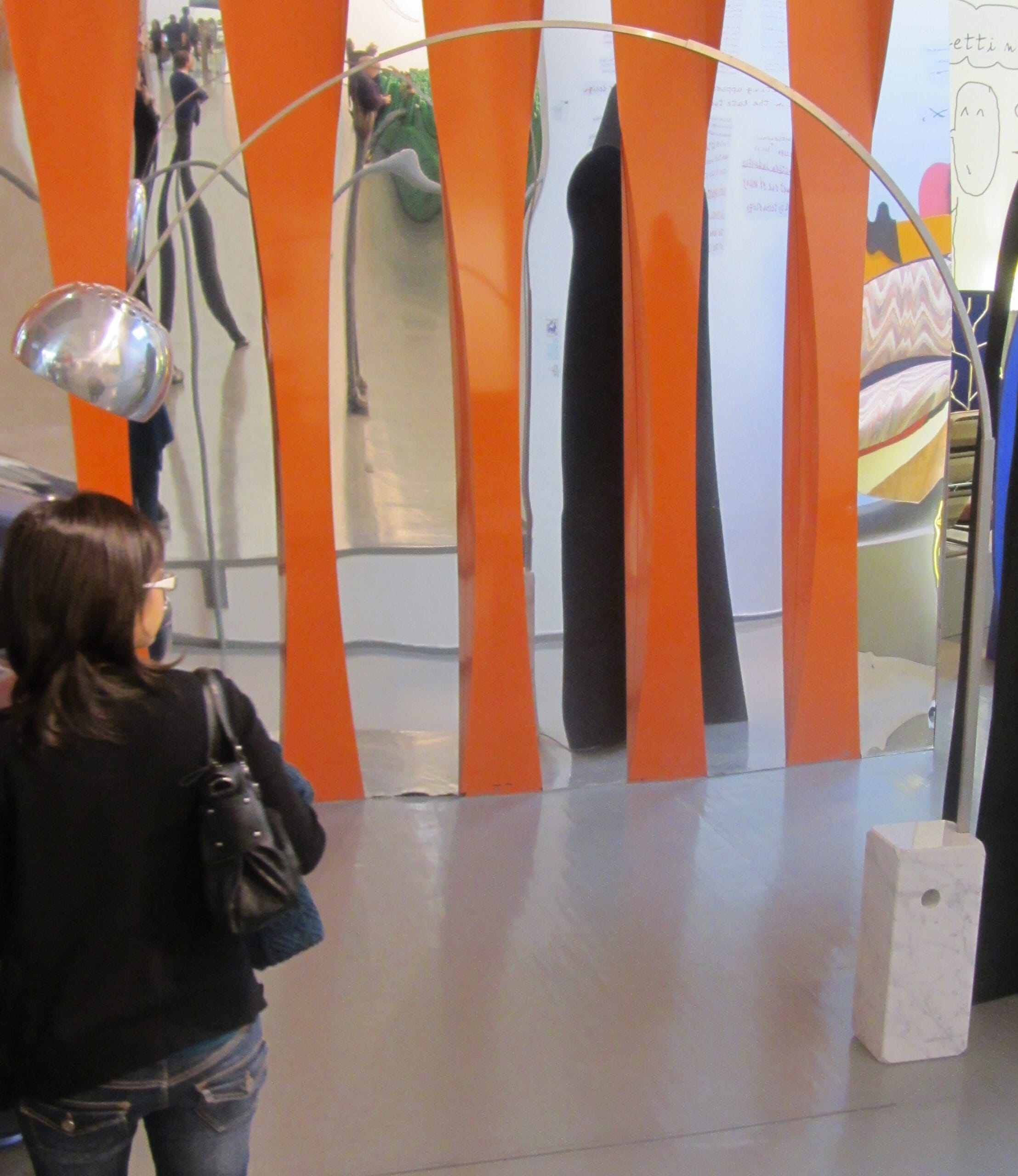
The Castiglioni Arco lamp is a floor lamp designed in 1962 by Achille and Pier Giacomo Castiglioni for Flos. A telescopic steel arc rises from a Carrara marble block and reaches more than six feet sideways, suspending an aluminum reflector over a table without any ceiling fixture. It stands 95 inches tall and has remained in production since 1962.
Why the Castiglionis Refused to Drill Into the Ceiling
Achille and Pier Giacomo Castiglioni were not solving a design problem in 1962. They were solving a rental problem. A tenant in a plaster-ceilinged Milanese apartment cannot drill a hole for a pendant fixture. A landlord will not let him try, either. So the brothers treated that restriction as the brief itself, not as an obstacle to design around. Once they accepted the ceiling as off-limits, the whole solution had to live on the floor. Their answer left the ceiling untouched entirely.
1962 was also the year Flos opened, in Merano. Cesare Cassina and Dino Gavina founded it, with the manufacturer Arturo Eisenkeil. Achille and Pier Giacomo were the company’s first designers. Its opening line, Arco, Toio, Taccia, and Relemme, all came out of that single studio in a single burst. Since the company had no back catalog, it staked its whole identity on four lamps. “The Arco is not a mature company’s classic. It is a startup’s opening argument.” The boldest of the four still made the biggest bet. It assumed a customer would accept a block of marble in the middle of a living room floor.
The Arco is not a mature company’s classic. It is a startup’s opening argument.
The arc’s source image is municipal, not domestic. Achille told his design students, “If you are not curious, forget it.” Flos later used that line as the title of its 2018 Milan Design Week retrospective of his work. A street lamp bends over a road because the light must clear traffic. It has to land on the pavement below. So the Arco simply shrinks that same geometry into a room.

Scandinavian design of the same decade solved for restraint. Designers there asked how much they could remove from an object before only function remained. The Castiglionis solved for gesture instead, for how far a single arm could reach before the room stopped believing it. That transposition explains the accent: public infrastructure walking into a dining room. The Arco reads as engineering with an accent, rather than as furniture with a story. Once you notice the street lamp underneath it, the domestic version never quite disappears again.
Achille was born in Milan in 1918. He graduated in architecture from the Politecnico di Milano in 1944. Then he joined the Milan studio of his elder brothers Livio and Pier Giacomo. The Arco belongs to the partnership’s late period. Pier Giacomo died in 1968, six years after the lamp’s release. Achille continued the practice alone until his own death in 2002. Retail copy often credits Achille alone. But he did not design the Arco by himself. Dropping his brother’s name is the kind of accuracy failure this piece avoids.
The lamp also belongs to the modern canon of objects people can name. That is the small set of designed things a non-specialist could sketch from memory. It earned that status alongside Vico Magistretti’s work, the same Milanese generation working the other side of the problem. Where the Castiglionis solved the ceiling problem with an arc of steel, Magistretti solved it differently. He used table lamps that stayed low, and argued for restraint instead of reach.
What the Castiglioni Arco Lamp Actually Does to a Room
The marble base is not decoration bolted onto an otherwise spare lamp. It is the counterweight, and the arc genuinely cannot stand without it. A cantilever that reaches 78.75 inches (200 cm) needs enough mass at the far end, or it tips forward. So Achille and Pier Giacomo made that requirement the object’s entire visual identity, instead of hiding it. They carved a 21.5-inch column of white Carrara marble, roughly 9.5 inches square. It does the job a cast-iron plate would do inside a cabinet.
The physics is the styling.
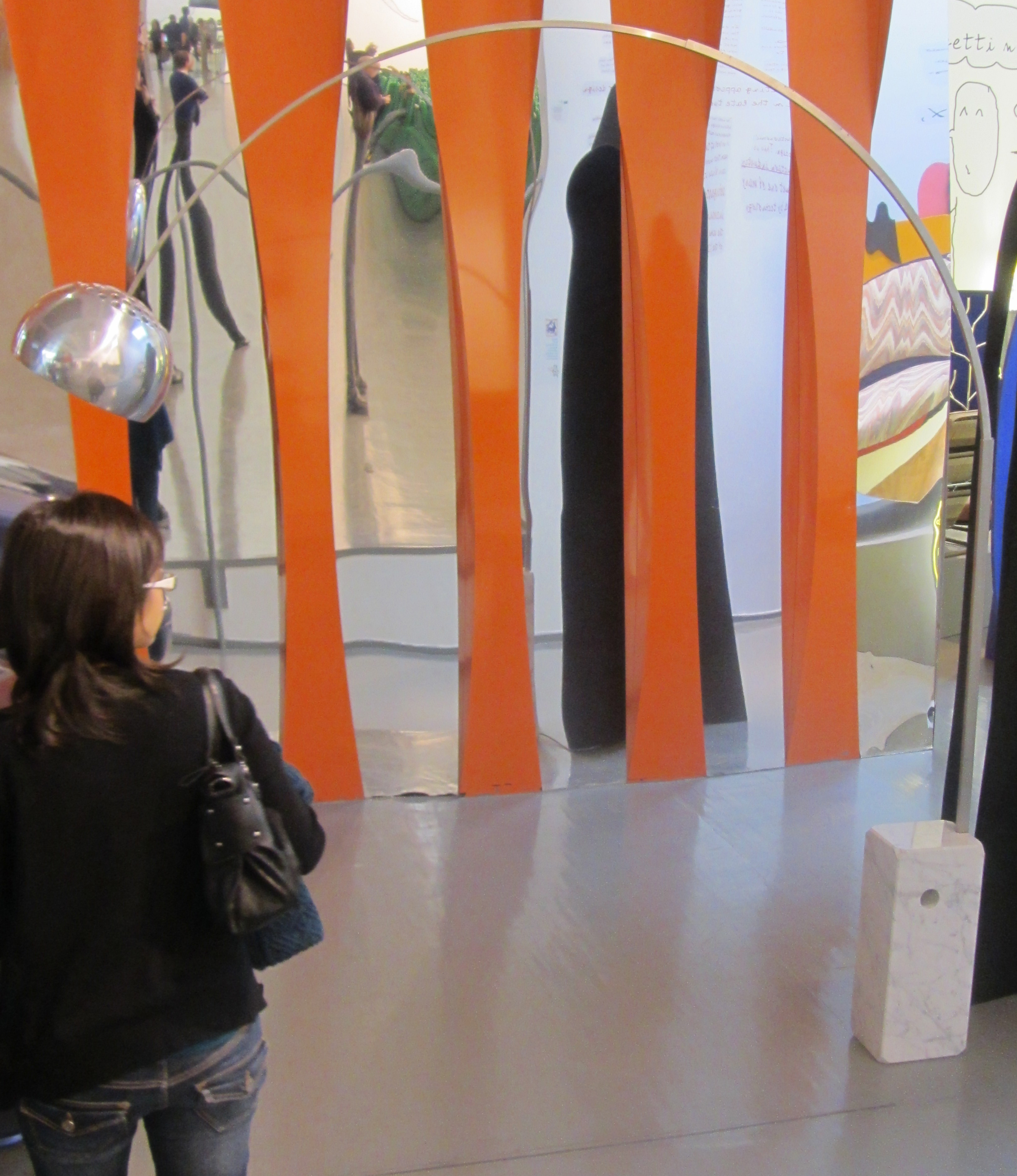
“The physics is the styling.” The lamp hides nothing. The marble is the mechanism, dressed in the one material heavy and handsome enough for public view. Even so, the base carries nearly all of the lamp’s weight. Published figures for that weight start around 65 kilograms and climb from there. Some sources count only the lamp. Others include the shipping crate instead.
The hole bored straight through that marble block proves the brothers were serious, not merely clever. According to Flos, the hole exists so two people can slide a broom handle through and lift the base. It is a moving instruction, cast into the object itself. Still, compare that to furniture that treats delivery day as somebody else’s problem.
At 95 inches (241.5 cm) tall, with a spun aluminum reflector 11.5 inches across, the Arco telescopes. So the stem lets the light over the table move independent of the ceiling. Once the table moves, the lamp follows it. Since light now belongs to furniture rather than architecture, the ceiling no longer matters. This is where the Castiglionis diverge most clearly from the restraint the Danes were selling in the same decade. A Scandinavian floor lamp of 1962 solved for disappearing into a room. The Arco instead solves for announcing exactly how it works, in public, at full scale.
None of this comes free. The arc needs floor space it does not visually occupy. It also needs a clear route in and out of the room on delivery day, given what the marble weighs. So say the trade-off plainly: an Arco, once placed, is close to permanent. It is a poor choice for a renter who might move next year. But it is a fair one for someone who has already decided this is the last apartment. The same problem still shows up at a smaller scale, on a desk. There, smaller lamps that have to solve the same problem on a desk face it too, minus the marble.
What Else Were the Castiglionis Making in 1962?
The Arco earned overdue recognition in 2020. That year, the Compasso d’Oro jury gave it a “Products Career Award.” That category honors designs that succeeded commercially for decades without ever winning the prize at launch. The lamp’s Wikipedia entry lays out that history. The Museum of Modern Art in New York also holds the lamp in its collection. It has since lived a second life as shorthand, rather than furniture. Two Arco lamps appear in Blofeld’s penthouse office in Diamonds Are Forever (1971), production design by Ken Adam. They join the Barcelona Chair among objects that stopped being furniture and became shorthand for taste on screen.
Toio and Taccia Ran the Same Experiment as Arco, Twice
Toio, also 1962, also Flos, is a floor lamp built around a car headlight. A telescoping stem mounts it, with the transformer left exposed at the base as ballast. Same year, same studio, same method: take an industrial part and refuse to disguise it. Toio is the argument the Arco makes, with the tailoring removed. Taccia sets an aluminum cylinder base under a glass bowl and reflector. The bowl simply sits on top, loose enough to rotate by hand. Where the Arco throws light sideways across a room, Taccia instead throws it back down onto itself.
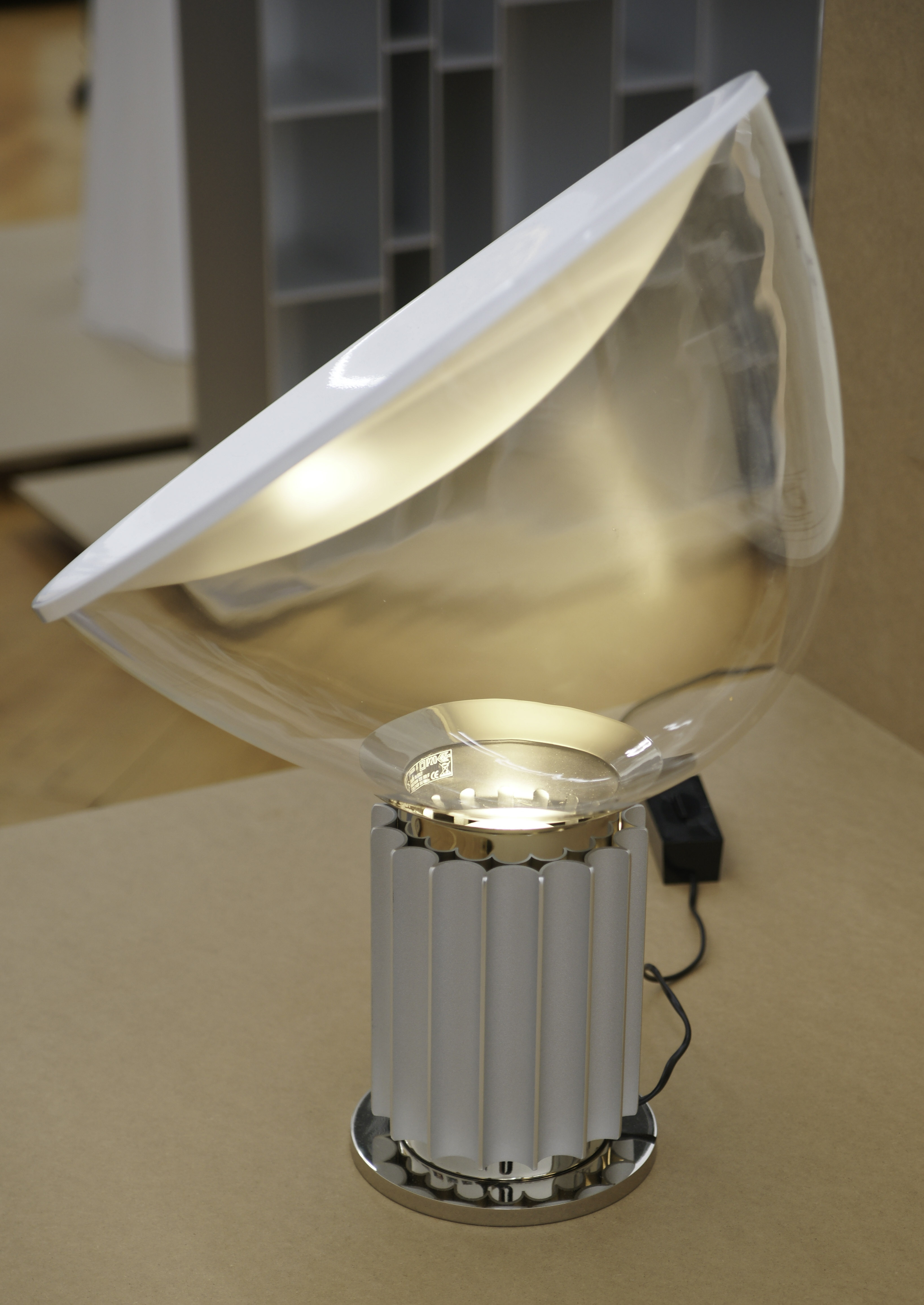
Mezzadro Explains Where the Method Came From, and Arco K Shows Where It Ended
Mezzadro, a 1957 design for Zanotta, is a tractor seat on a steel cantilever, tightened with a bicycle wing nut. It predates the Arco by five years, and explains it. Taking an industrial object and repositioning it was studio doctrine long before Flos existed. At the other end of the timeline sits Arco K, a 2022 limited edition marking the lamp’s sixtieth year. It replaces the Carrara base with lead-free crystal. Once the counterweight becomes transparent, the object is quoting itself. Arco LED, the current production version, still keeps the original geometry, though now with an integrated LED source. It is the version most buyers today actually take home.
Shop the Collection
Stock check, 21 September 2026: the Flos Arco, in both LED and incandescent form, is not sold on Amazon.com right now; the listings this page carried at publication have gone. Flos sells through Lumens, Design Within Reach and its own site. ADI does not link to unlicensed versions of the Arco. One arc lamp on Amazon that borrows nothing from it is worth the money.
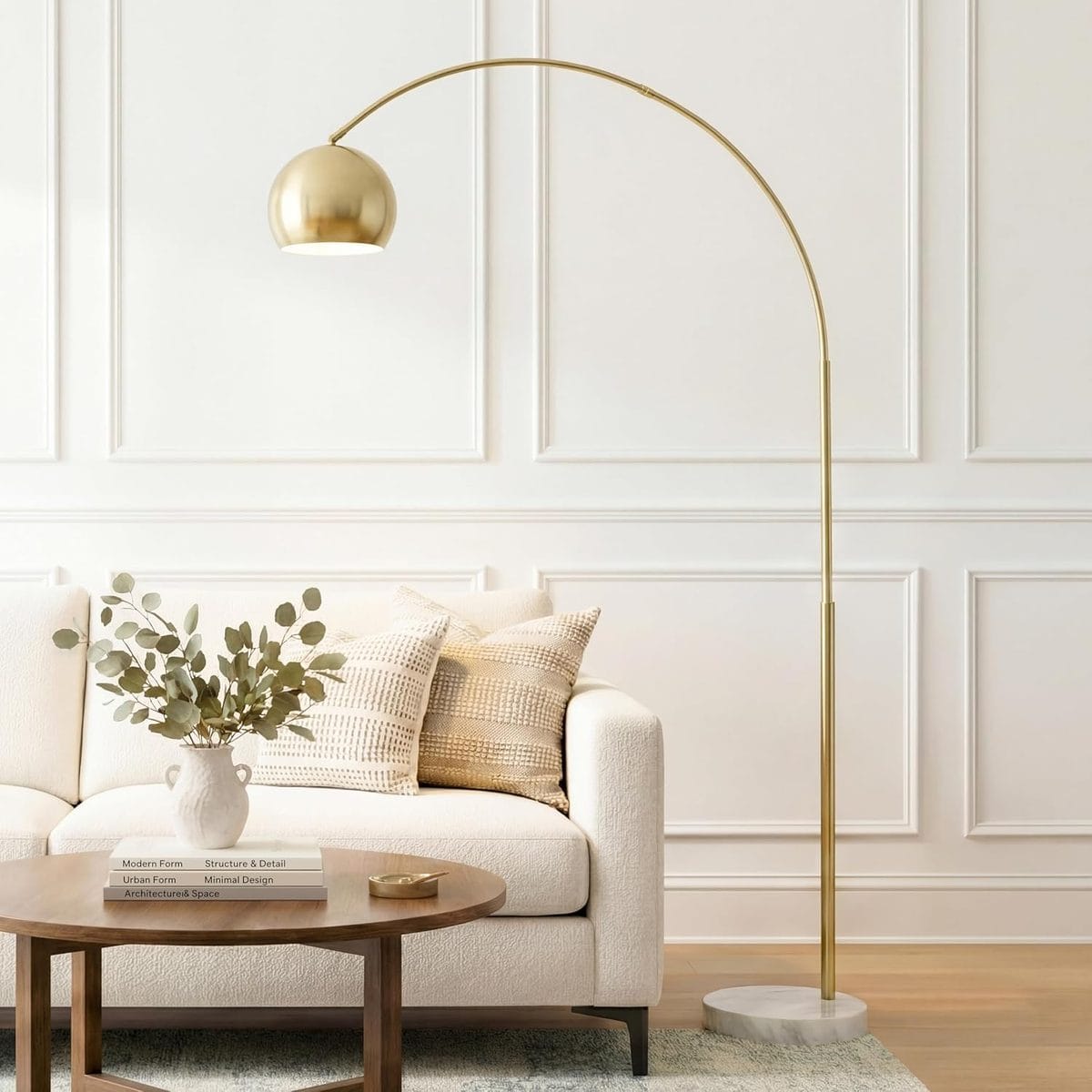
Brightech Olivia Arc Floor Lamp
Not an Arco copy and not pretending to be one: a brass-finish arc with a 9-inch globe shade on a genuine marble base, LED bulb included, about $200 with 460-plus reviews at 4.4 stars. It solves the same problem the Castiglionis set themselves, light over the table without a ceiling fixture, at about a twentieth of the Flos price.
Further Reading
Two of these three books are still worth owning outright. The third earns its place for a single argument it makes that nothing else does.
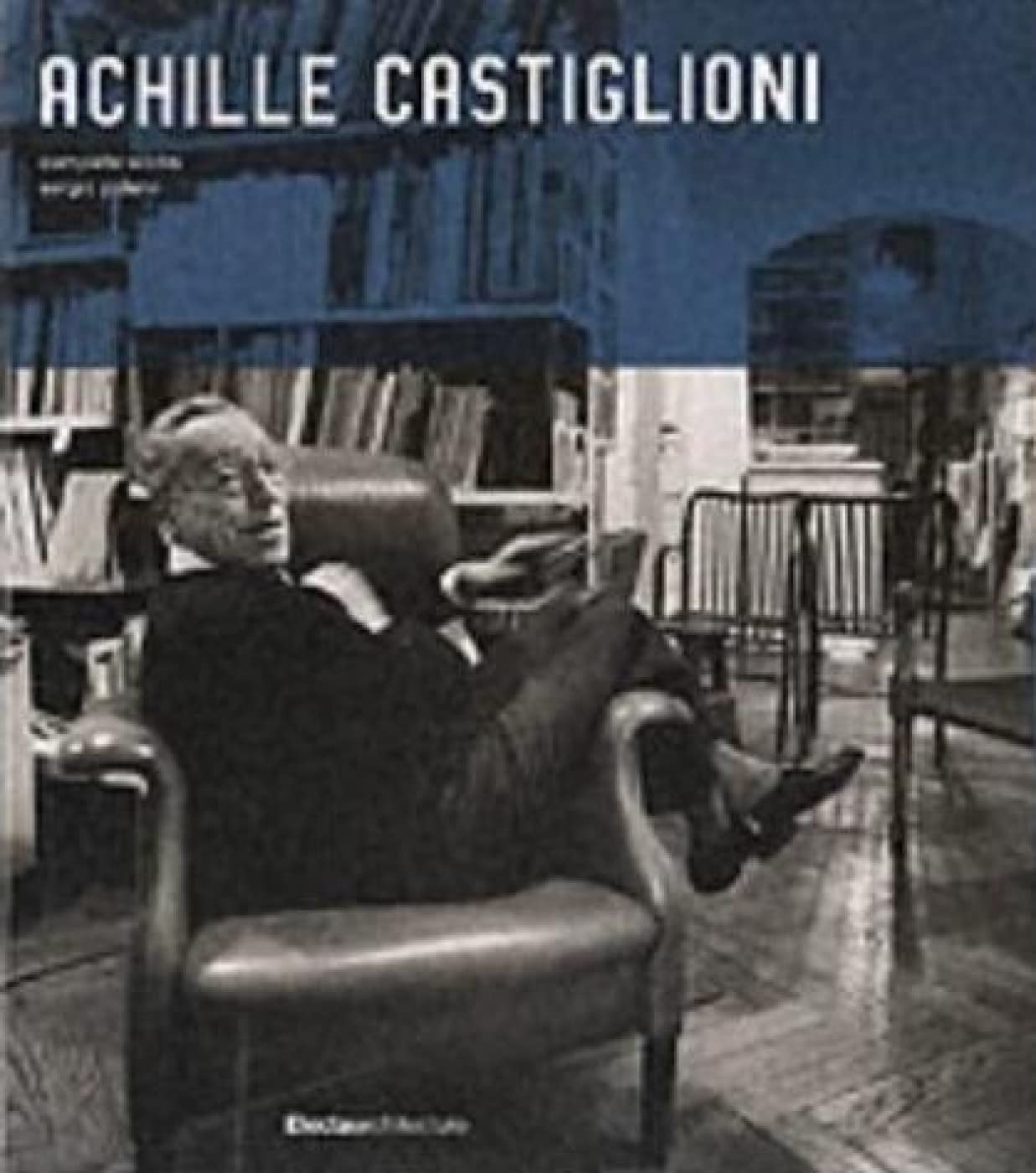
Sergio Polano, Achille Castiglioni: Complete Works (Electa/Phaidon, 2002)
Is built from the studio archive across 476 pages. Every project gets a critical description, rather than a caption. It is the book that shows the Arco as one decision inside a fifty-year method, instead of a standalone classic.
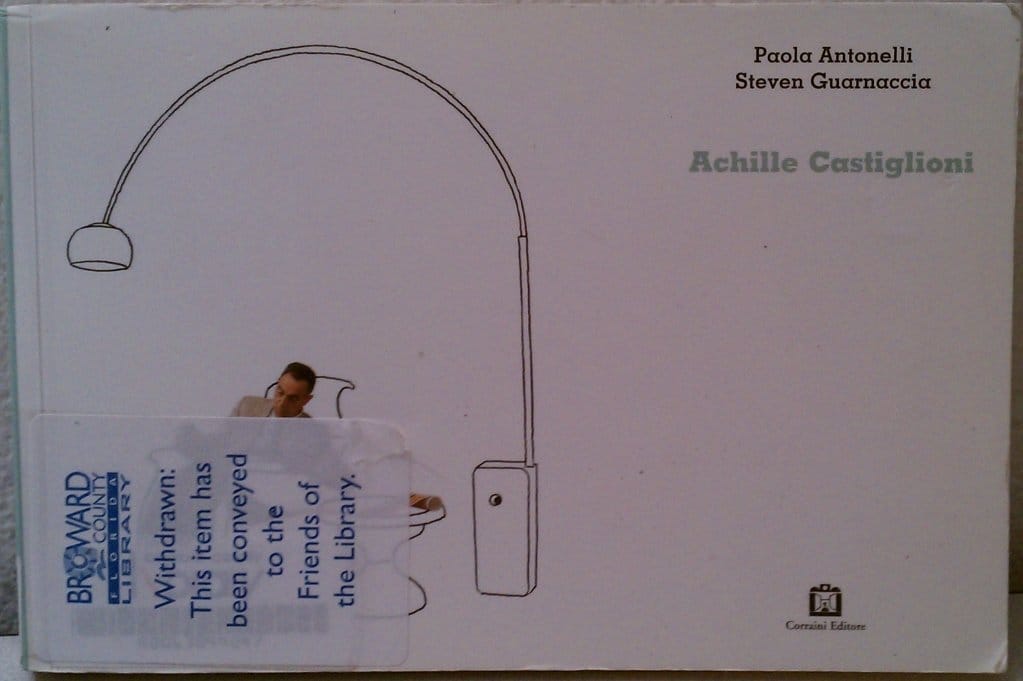
Paola Antonelli and Steven Guarnaccia, Achille Castiglioni (Corraini)
Grew out of Antonelli’s 1997 Castiglioni exhibition at MoMA. So it reads as curatorial argument, rather than catalogue. It remains the cheapest serious way into the work.
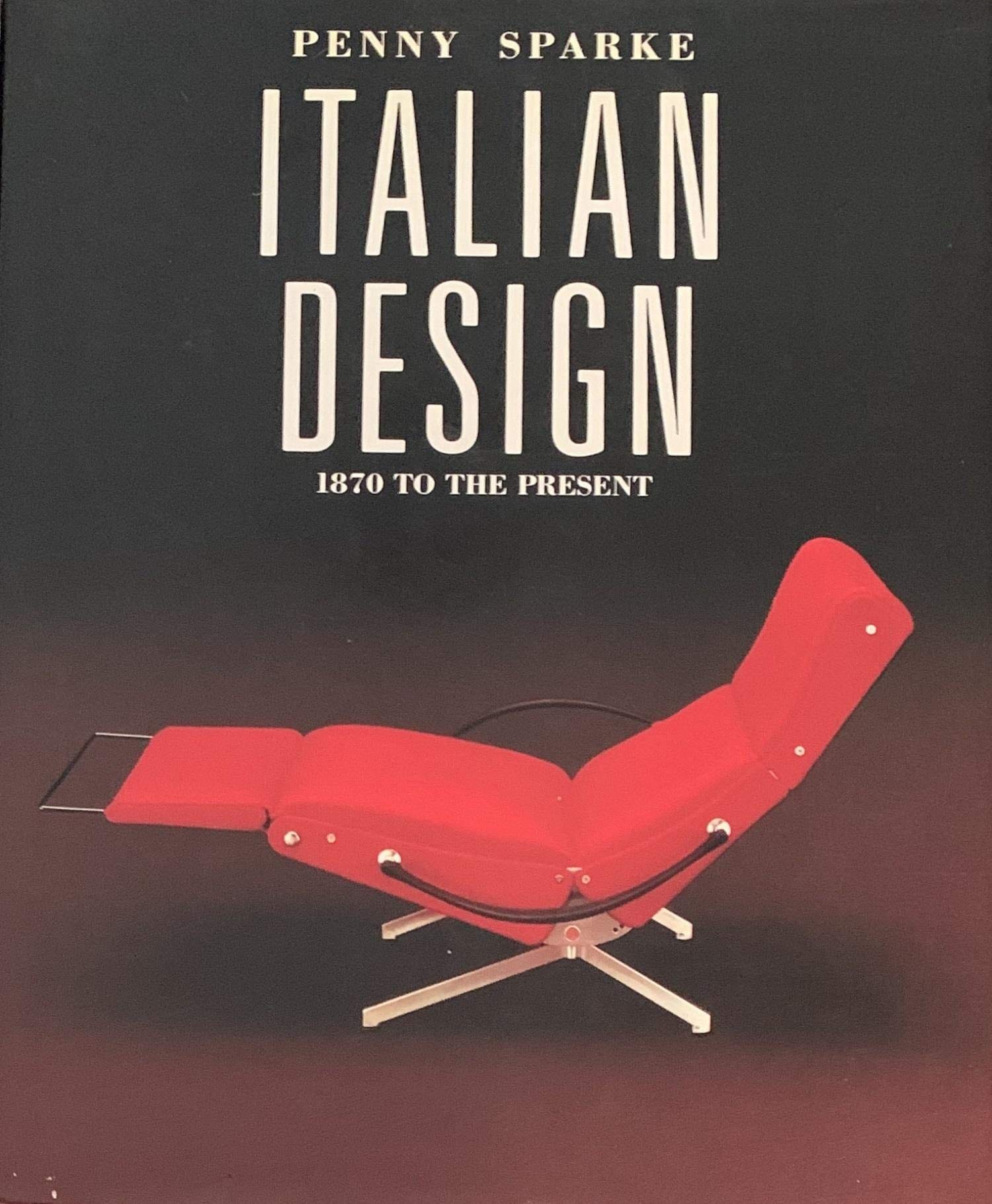
Penny Sparke, Italian Design: 1870 to the Present (Thames & Hudson, 1988)
Traces the relationship between Italian designers and the industrialists who backed them. It explains why a brand-new company in Merano still handed its opening product line to two architects from Milan.
Frequently Asked Questions
Who designed the Arco lamp?
Achille Castiglioni (1918-2002) and his brother Pier Giacomo Castiglioni (1913-1968) designed the Arco in 1962, for Flos. The Museum of Modern Art credits both brothers. Single-designer credits to Achille alone are common in retail listings. But they are incomplete. Pier Giacomo was still five years from his own death when the lamp appeared. He was fully active in the studio at the time.
What is the Arco lamp made of?
Three materials make up the Arco. There is a white Carrara marble base, a telescopic satin stainless steel arc, and a spun, polished aluminum reflector. No housing hides any part of the lamp. Instead, the three materials that hold it up and throw the light are the same three materials you can see.
How much does the Arco lamp weigh, and can one person move it?
The marble base carries nearly all of the lamp’s weight. Published figures vary, since sources count different things. But most European retail listings cluster around 65 kilograms, roughly 143 pounds, for the lamp itself. US shipping-weight quotes run higher. It is a two-person move. That is why the base still has a hole for a broom handle.
How much space does an Arco lamp actually need?
Plan around the reach of the arc, not just the footprint of the base. The arm extends about 200 cm (78.75 inches) from a base that occupies roughly 24 by 24 cm. The whole lamp stands 241.5 cm (95 inches) tall. The base sits against a wall or behind seating. So the light still lands over the table, several feet away from where the weight actually is.
Is the Flos Arco lamp worth the price?
Current Flos list pricing starts around $4,095, with the limited-edition Arco K running about $12,600. The case for that price rests on production continuity, rather than novelty. This is a design that has been in unbroken manufacture since 1962, in the original materials. It also has a documented resale market behind it. Whether that is worth the money still depends on what you think you are buying. Are you buying an object, or forty more years of not having to replace it?
Is it legal to sell a lamp that looks like the Arco?
The silhouette is still widely copied and openly sold. Flos has fought to defend the original in Europe. In 2006, the company sued Semeraro Casa & Famiglia SpA over a lamp called Fluida. A court ordered production halted under EU design protection rules put in place in Italy in 2001. What no other maker may legally do is use the Flos or Arco names to sell its lamp as the original.

About Joe Post
Joe Post holds an MFA in Art from California Institute of the Arts (CalArts) and has done additional graduate work at the School of the Art Institute of Chicago. He founded Art Design Ideas to write about design as cultural argument — the decisions, contradictions, and assumptions built into the objects we live with.