
Kerry James Marshall, painter, has spent four decades placing Black figures at the center of Western representational painting, not as documentary subjects, but as the legitimate material of the medium’s highest ambitions. Born in Birmingham, Alabama in 1955, he has built a counter-archive to the canon’s omissions.
What Marshall decided his painting would do
Marshall was ten years old when the Watts uprising happened, and he was present for it. He was living in South Central Los Angeles after moving there from Birmingham in childhood. He has cited both environments directly as the context for understanding that Black life was systematically absent from visual representation. This is not biographical color. It is the explanatory frame for a formal decision that defined the next five decades of his work.
At Otis Art Institute in Los Angeles, where he completed his BFA in 1978, Marshall studied figure drawing under Charles White, a social realist painter whose influence ran through the tradition of politically engaged American figurative painting. White taught him to take the human figure seriously as a carrier of historical meaning. That inheritance is visible in every painting Marshall has made since.
The formal decision at the center of the practice came from a specific diagnosis: Marshall looked at the Black artists who had worked within Western figurative painting and observed how they had managed the problem of the Black figure. As he put it in a statement published in ArtReview: “The only way [black artists] could stay with the black figure was by compromising it — by either fragmenting it, or otherwise distorting it, by making it green, blue or yellow, or some other way to deflect the idea of its blackness.” Marshall refused that deflection.
He made his figures as dark as paint can make them, not as a symbol but as a rhetorical position. The darkness is a claim about what the figure can hold.
In 1985 he began a residency at the Studio Museum in Harlem, then moved to Chicago in 1987. From 1993 to 2006 he taught painting at the School of Art and Design at the University of Illinois at Chicago. The institutional placement matters: Marshall was not working from the margins of the art world but from inside its pedagogical infrastructure, making a claim on the medium’s terms. His first solo show with Jack Shainman Gallery opened in 1993, the same year he joined the UIC faculty. By that point the argument was already structural, not just aspirational.
This trajectory, from Birmingham to Watts to Otis to Harlem to Chicago, parallels, in its own way, earlier moments when the visual canon was explicitly contested and remade, as in the Art Deco era’s negotiations between tradition and rupture. What distinguishes Marshall is that he contested the canon from within its own terms: not by proposing an alternative to Western painting, but by demonstrating what Western painting had failed to contain.
How Kerry James Marshall’s paintings work: structure, not statement
Marshall operates within the established genres of Western painting (history painting, portraiture, landscape, genre scenes, the nude) and populates them entirely with Black subjects. The argument is structural. By showing that Black life can occupy every genre, every compositional register, every level of technical sophistication, he expands the canon from within rather than proposing something beside it.
His phrase for what his work addresses is “the lack in the image bank,” his own formulation, cited at Jack Shainman Gallery and David Zwirner. The lack is not an absence of Black artists; it is an absence of Black figures in the dominant visual tradition. Marshall’s project is to fill that bank. He and his critics have used the term “counter-archive” to describe this: a systematic body of images that can sit alongside the existing canon and change what the canon is, rather than standing as an exception to it.
“The lack in the image bank is not an absence of Black artists. It is an absence of Black figures in the dominant visual tradition.”
The formal range of the work is deliberately wide. The Garden Project series (1994–1997) operates in the tradition of American Social Realism and Dutch domestic genre painting. Katy Siegel and others made this case in the critical literature around the Mastry retrospective. The Vignette series (2003 onward) references the compositional and chromatic conventions of Rococo genre painting. The History of Painting series, documented in the 2020 David Zwirner catalog with essays by Hal Foster and Teju Cole, turns to painting itself as its explicit subject: abstraction, the art market, auction mechanics.
Each series plants Black subjects inside a tradition that had historically excluded them, and does so with enough technical command that the exclusion becomes visible as a choice, not a given.
The MacArthur Fellowship Marshall received in 1997 came at the moment the critical apparatus was catching up to what he had been arguing since the late 1970s. That year he appeared at Documenta X and the Whitney Biennial. By 2003 he was at the Venice Biennale. The major retrospective, Kerry James Marshall: Mastry, opened at MCA Chicago in 2016, traveled to the Metropolitan Museum of Art and MOCA Los Angeles, and established the critical consensus around the practice.
In Art21, Marshall described the formal logic this way: “The initial development of that unequivocally black, emphatically black figure was so that I would use them as figures that function rhetorically in the painting. That kind of extreme is a rhetorical device.” That statement is the thesis in a sentence. The paintings are not documents of Black life. They are arguments about painting, about who gets to be a subject of its highest ambitions and at what level of technical address.
“The paintings are not documents of Black life. They are arguments about painting — about who gets to be a subject of its highest ambitions.”
This is also how Marshall’s practice differs from, say, Karen Kilimnik’s work, which also engages art-historical citation. Kilimnik borrows from Romanticism, theatrical traditions, and popular imagery, but through a register of irony and quotation that keeps its distance from the canon. Marshall is not quoting the canon from outside. He is claiming it.
The collections that now hold the work confirm the argument was heard. They include the Art Institute of Chicago, LACMA, the Metropolitan Museum of Art, MoMA, the National Gallery of Art, SFMOMA, the Whitney Museum, the Studio Museum in Harlem, and the Walker Art Center. That list is not incidental; it is the institutional record of the canon accepting the claim.
Five paintings that make the argument
Marshall’s project is visible across everything he has made, but five paintings show the full scope of the argument.
Many Mansions (1994)
Acrylic and collage on canvas, 114 x 135 inches. Art Institute of Chicago. This is the first of the Garden Project series, set in Stateway Gardens, a Chicago public housing development. Figures rendered in the deepest possible dark paint tend an impossibly lush and colorful garden, flowers cascading against the bleak housing architecture. The title comes from the Gospel of John: “In my Father’s house are many mansions.”
The cheerfulness of the garden is not naïve; it sits against the gravity of the setting, and one figure looks directly at the viewer, breaking the fourth wall of the genre scene. The painting works at the scale of history painting. At 114 x 135 inches it is not a domestic interior; it uses the compositional logic of Dutch genre, with figures absorbed in ordinary tasks. The scale forces the question: why hasn’t this subject been given this treatment before?
Souvenir I (1997)
Acrylic and glitter on unstretched canvas banner, 108 x 157 inches. Held in the collection of the Metropolitan Museum of Art. The painting is hung by grommets, not stretched over bars. That format invokes the memorial banner tradition, not the easel painting tradition. Set in a middle-class Black domestic interior, it commemorates figures who died in the civil rights movement, whose faces appear as presences in the upper register of the image. The glitter is not decoration. It is the halo tradition in early Christian painting, marking figures as outside ordinary time. Domestic genre, memorial form, and icon tradition converge in the same surface. That convergence is Marshall’s method.
School of Beauty, School of Culture (2012)
108 x 157.5 inches, collection of the Birmingham Museum of Art. A beauty salon interior filled with Black figures going about the ordinary business of the space. Marshall structures the painting using formal conventions from European Old Master portraiture: a stable compositional arrangement, light distributed from a defined source, figures placed at calculated intervals across the picture plane: the organizational logic of the interior genre at its most deliberate.
A red, black, and green border (the Pan-African flag) runs below the salon’s name painted on the wall. The painting makes a direct claim: this space, entirely familiar to most African Americans, is as legitimate a site of cultural transmission as any European interior the tradition has dignified with this level of compositional attention.
The arguments about which interiors get painted are arguments about whose culture counts.
Vignette #19 (2010)
Acrylic on PVC, 108 x 144 inches, Metropolitan Museum of Art. The Vignette series is Marshall’s direct engagement with Rococo genre painting: the amorous couple, the idealized garden setting, the soft chromatic key of pink and pale green. Marshall places Black figures inside these conventions with no ironic distance. The darkness of the figures against the Rococo ground is not a contrast for its own sake; it is an assertion that these figures belong in these traditions and that the traditions can hold them. What looks like a juxtaposition is actually a statement about continuity.
Past Times (1997)
Oil and acrylic on canvas, 110 x 160 inches. Set in a Chicago park, with figures engaged in leisure (boating, a barbecue, golf, a game of croquet) against a scale and compositional ambition that invokes 19th-century American landscape painting. Marshall has described leisure as an understudied subject in the painting of Black life, and Past Times makes the point directly: the painting gives figures engaged in pleasure the monumental treatment that tradition reserved for heroic subjects. The movements that defined what Western design and painting could legitimately contain were always arguments about inclusion and exclusion. Past Times makes the same argument in the genre of the American leisure landscape.
Shop the Collection
Marshall’s work is held by institutions, not sold in shops, but the catalog literature is among the best critical writing on contemporary painting. Two books earn their place on the shelf.
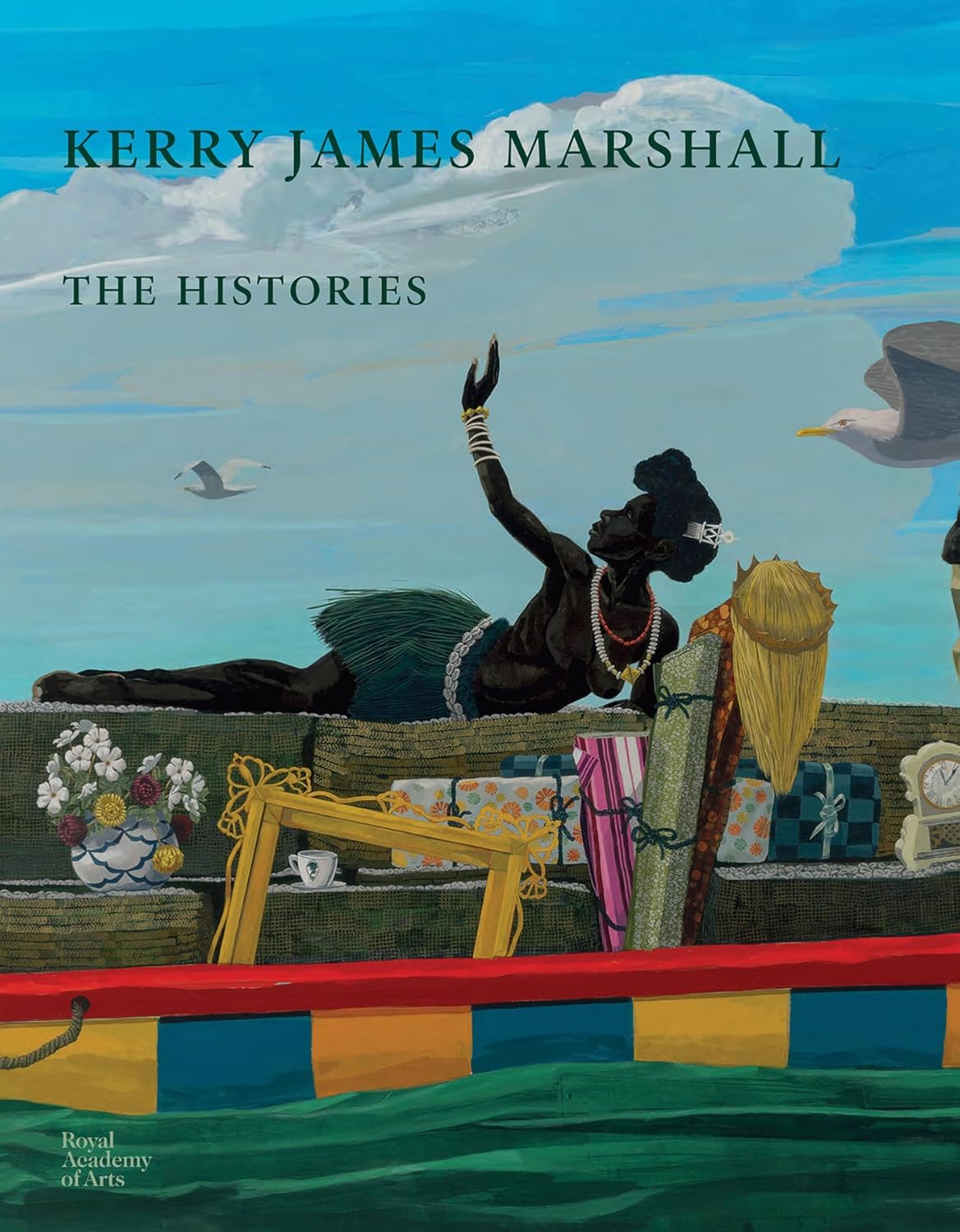
Kerry James Marshall: The Histories (Phaidon/Serpentine, 2023): The most comprehensive survey of the career to date, with essays by Benjamin Buchloh, Mark Godfrey, and Aria Dean. Read this to understand how critics have positioned the work against the history of painting.
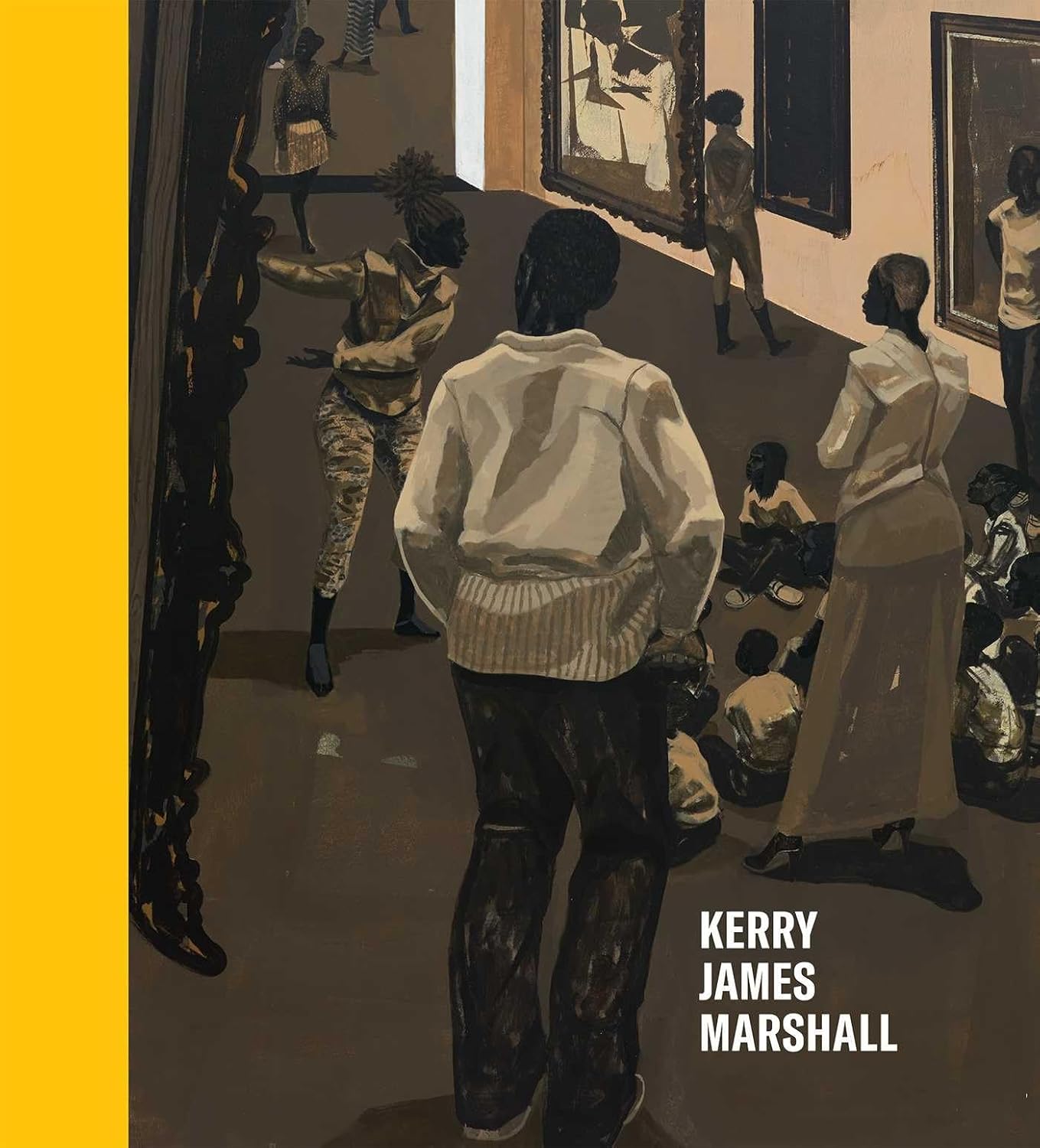
Kerry James Marshall: History of Painting (David Zwirner Books, 2020): Documents the body of work in which Marshall turned to painting itself as his explicit subject: abstraction, auction catalogues, art market mechanisms. Essays by Hal Foster and Teju Cole make this the most rigorous engagement with what the late work is doing.
Further Reading
The critical literature on Marshall is unusually strong. These two books are worth owning, not just consulting.
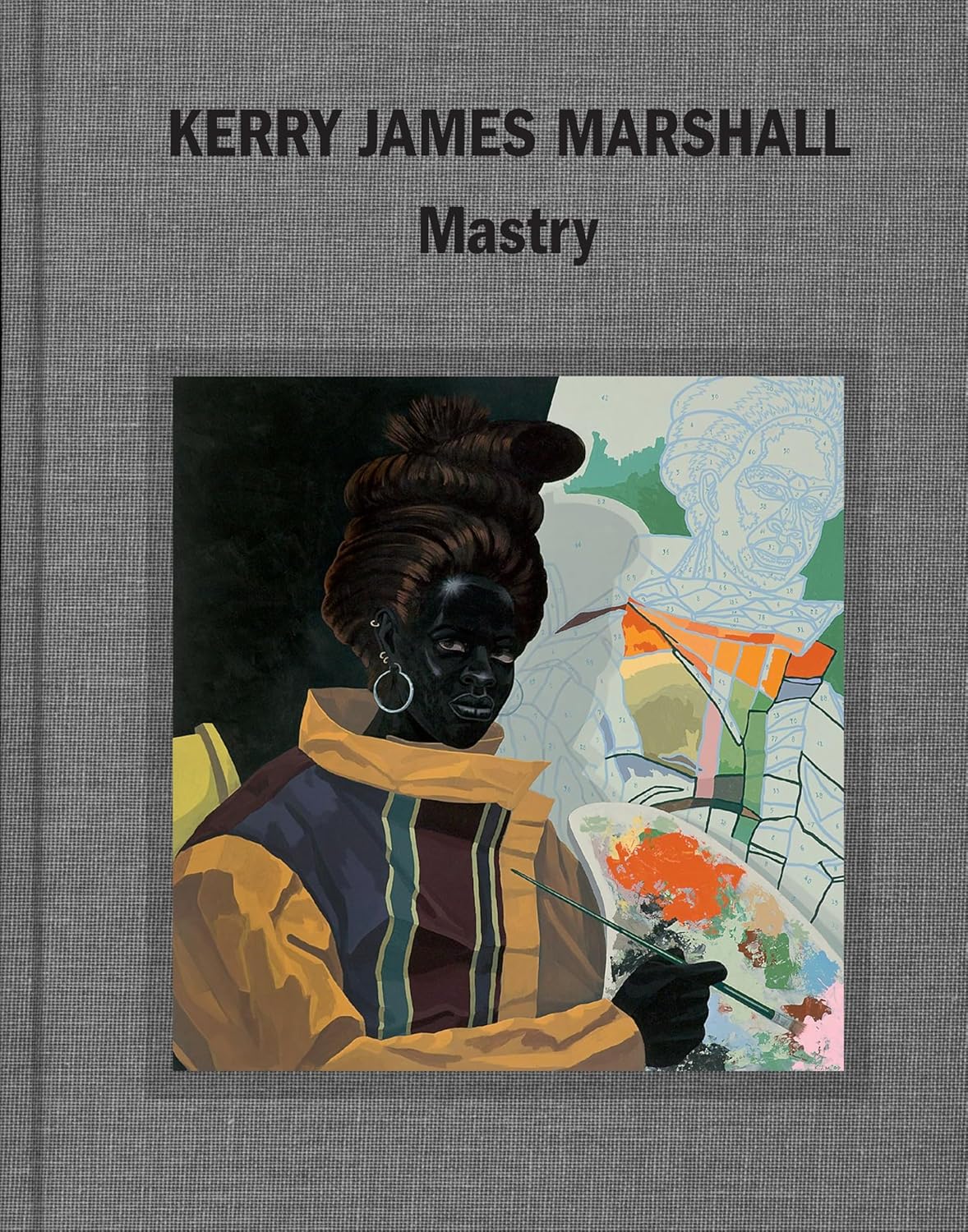
Ian Alteveer, Helen Molesworth et al., Kerry James Marshall: Mastry (Rizzoli, 2016): The retrospective catalog edited by MOCA Chief Curator Helen Molesworth remains the single most authoritative account of the practice. The critical consensus was established here, and the full range of the work was put on view for the first time.
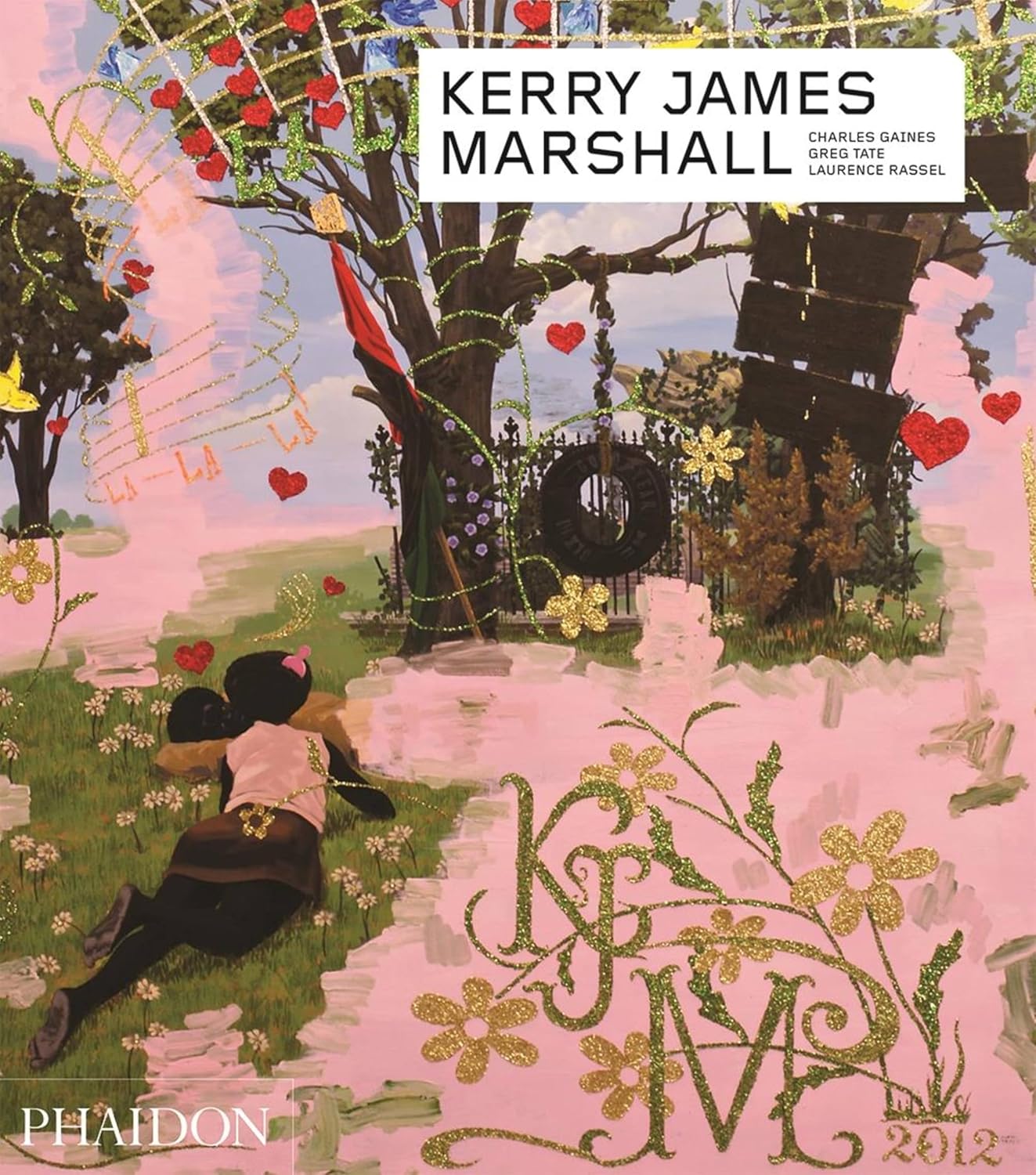
Kerry James Marshall, Kerry James Marshall (Phaidon Contemporary Artists Series, 2000): Phaidon’s entry-level monograph includes essays by Charles Gaines, Laurence Rassel, and Greg Tate. The right starting point for a reader who wants critical scaffolding before moving to the larger retrospective catalogs.
Frequently Asked Questions
What is Kerry James Marshall known for?
Marshall is known for paintings that place Black figures at the center of Western painting’s established genres (history painting, portraiture, landscape, genre scenes) with the technical command and compositional ambition those genres require. His practice makes a formal argument: the absence of Black figures from the dominant visual tradition was a structural exclusion, not an aesthetic necessity, and painting can correct it.
Why does Kerry James Marshall paint figures so dark?
Marshall has described the darkness of his figures as a rhetorical device, not a symbolic statement. As he explained to Art21: “The initial development of that unequivocally black, emphatically black figure was so that I would use them as figures that function rhetorically in the painting. That kind of extreme is a rhetorical device.” Earlier Black artists, he observed, often compromised the Black figure by fragmenting it or shifting its color to avoid confronting its blackness directly. Marshall refused that compromise.
How does Marshall’s work relate to Western art history?
Marshall works from within Western painting’s established genres. He does not propose an alternative tradition. His method is to take the compositional structures, the scale, and the technical standards of Dutch genre painting, Rococo fantasy, history painting, and the American landscape tradition, and populate them with Black subjects. The argument is that those genres have always been capable of holding these figures; the absence was a choice, not a formal limit. He describes his project as filling “the lack in the image bank,” his phrase for the systematic underrepresentation of Black figures in the dominant visual tradition.
What is the Mastry retrospective?
Kerry James Marshall: Mastry was a major retrospective exhibition that opened at the Museum of Contemporary Art Chicago in 2016, then traveled to the Metropolitan Museum of Art in New York and MOCA Los Angeles. It was the first comprehensive survey of Marshall’s career, bringing together work from across four decades. The accompanying Rizzoli catalog, edited by MOCA Chief Curator Helen Molesworth, established the critical framework through which the practice is now understood.
Who are Kerry James Marshall’s major influences?
Charles White, the American social realist painter under whom Marshall studied figure drawing at Otis Art Institute, is the influence Marshall has documented directly. White taught him to take the human figure seriously as a bearer of historical meaning, a position visible in everything Marshall has painted since. Marshall’s work also engages the compositional and genre traditions of Dutch painting, Rococo painting, American Social Realism, and American landscape painting, though these are influences absorbed through the practice of the work rather than named sources Marshall has cited in interviews.
Where can I see Kerry James Marshall’s paintings?
Marshall’s work is held by major institutions across the United States, including the Art Institute of Chicago, LACMA, the Metropolitan Museum of Art, MoMA, the National Gallery of Art, SFMOMA, the Whitney Museum, the Studio Museum in Harlem, and the Walker Art Center. Many of these institutions have works on permanent display or in accessible study collections. Marshall is represented by Jack Shainman Gallery in New York and David Zwirner internationally.

About Joe Post
Joe Post holds an MFA in Art from California Institute of the Arts (CalArts) and has done additional graduate work at the School of the Art Institute of Chicago. He founded Art Design Ideas to write about design as cultural argument — the decisions, contradictions, and assumptions built into the objects we live with.