The best Noguchi coffee table reproductions are unlicensed versions of Isamu Noguchi’s 1944 design: a three-piece table consisting of two interlocking curved wood legs and a triangular glass top. The strongest options use solid hardwood bases and glass at least 19mm thick. The original remains in production through Herman Miller (US) and Vitra (Europe).
Our Top Picks
The reproduction market for this table is wide. Most of it is mediocre. A few brands have figured out that the base material and the glass thickness are the only things that actually matter, and those are the ones worth looking at.
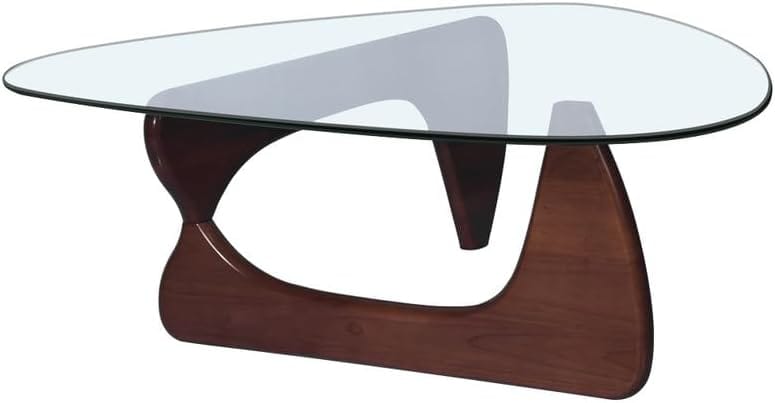
HuPoFun Isamu Noguchi Table Reproduction — Dark Walnut (Best Overall)
Price tier: Mid-Range
The HuPoFun Dark Walnut is the one to start with. The proportions track the original closely. The hardwood base is solid, not MDF dressed up to look like wood. It ships in configurations you can actually choose between: the standard 0.47-inch glass or the 0.75-inch version that matches the original post-1965 Herman Miller spec.
Pros:
- Solid hardwood base, not MDF or particleboard
- Available in 0.75-inch glass thickness matching original spec
- Multiple finish options (dark walnut, white, black, cherry)
- Correct proportional geometry between base elements
Cons:
- 0.47-inch glass version undershoots original spec; order the 0.75-inch if glass thickness matters to you
- Heavier than it looks; delivery requires two people
Who it’s for: Someone who has done enough research to know what they’re comparing against and wants the shape without the $1,500 Herman Miller price.
Why it stands out: It’s the only reproduction line where you can choose 0.75-inch glass at this price tier, which is the specification Herman Miller has used since 1965.
The only reproduction line where you can choose 0.75-inch glass at this price tier — the specification Herman Miller has used since 1965.
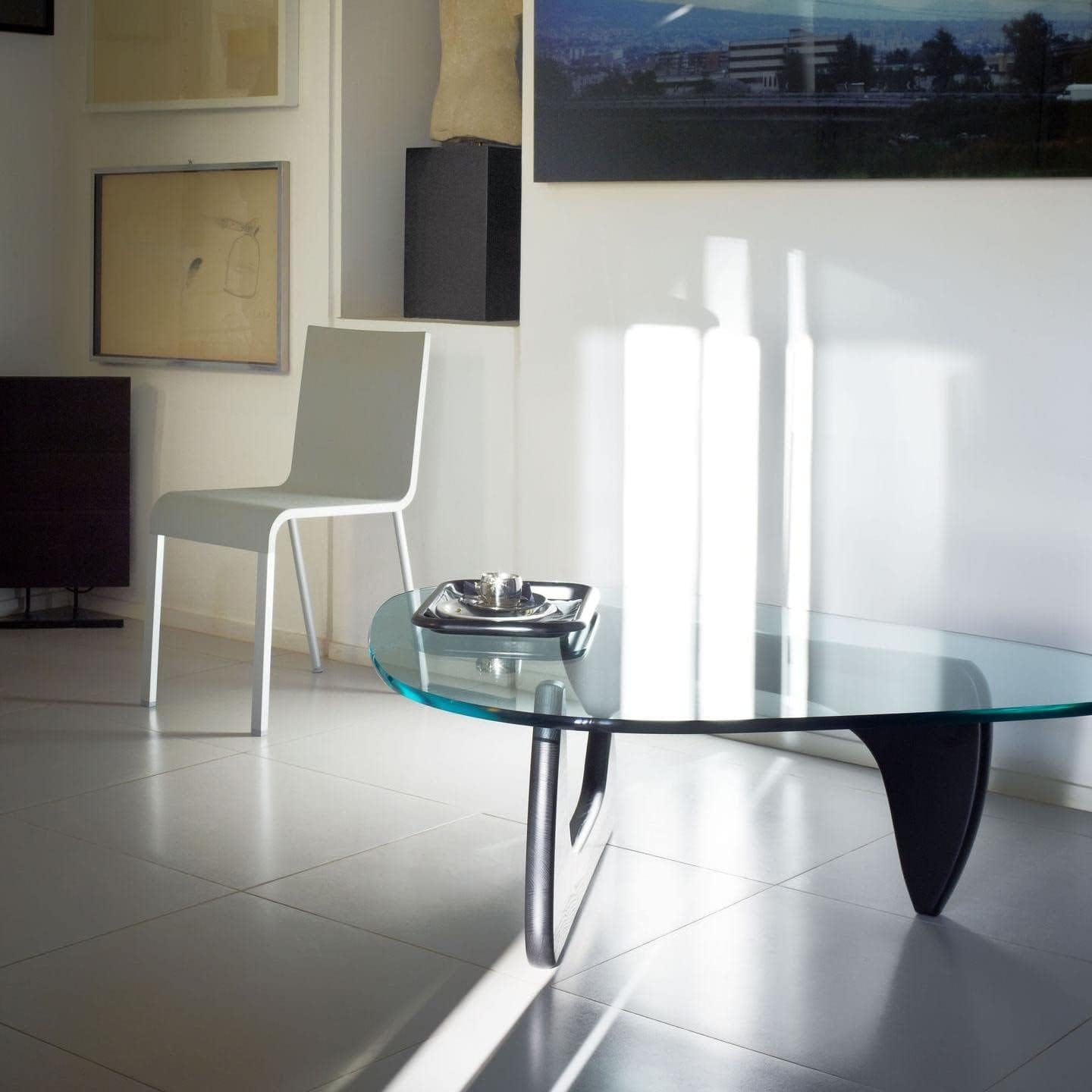
eChamp Noguchi Table — Black (Best Budget)
Price tier: Budget
The eChamp Black is the budget option that doesn’t compromise on the things that matter. Solid wood base. Three-quarter-inch glass. The geometry is right. What you give up is some finish refinement: the sanding and lacquer aren’t at the level of more expensive options. The structural decisions are correct.
Pros:
- Solid wood base confirmed, not MDF
- 3/4-inch glass (19mm) matches original specification
- Accessible price point under $300 at most sellers
- Black finish works in contemporary rooms that aren’t doing strict mid-century
Cons:
- Finish quality (sanding, lacquer) is a step below mid-range options
- Black only, no warm wood-tone option in this line
- Less variety in glass thickness choices than HuPoFun
Who it’s for: The buyer who knows the original spec (19mm glass, solid wood) and wants to meet both criteria without paying mid-range prices.
Why it stands out: At the budget tier, most competitors use MDF bases or thin glass. eChamp uses neither.
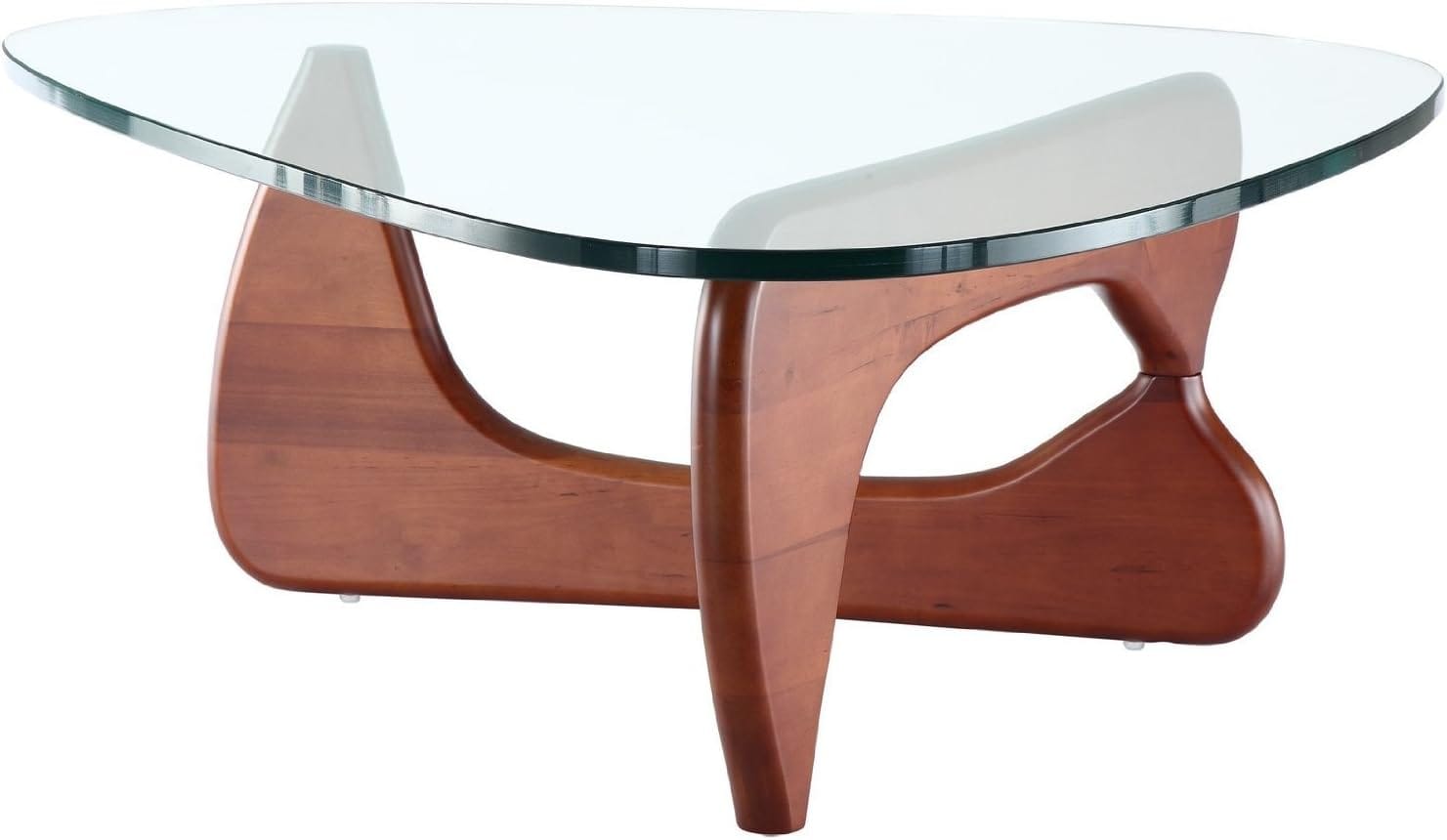
eMODERN FURNITURE eMod — Cherry (Best for MCM Rooms)
Price tier: Mid-Range
eMod has been selling this table longer than most reproduction brands. The cherry finish is the reason to choose this one over the walnut and black options: cherry bases existed only in 1947, the first year of Herman Miller’s production run, making them the rarest original variant. In a warm mid-century modern room, a cherry-finish reproduction reads as a considered choice rather than a default.
Pros:
- Long-running seller with consistent production and quality control
- Cherry finish references the rarest original production year
- Hardwood base confirmed
- Established return and service record as a brand
Cons:
- Glass thickness not always specified clearly in listings; verify before purchasing
- Cherry finish shows fingerprints and smudges more than darker finishes
- More expensive than the eChamp at similar material quality
Who it’s for: Someone furnishing a warm-toned mid-century modern interior who wants the finish choice to make sense in context.
Why it stands out: Cherry bases were discontinued after 1947. A cherry reproduction in an MCM room isn’t just picking a color. It’s picking the correct color for the period.
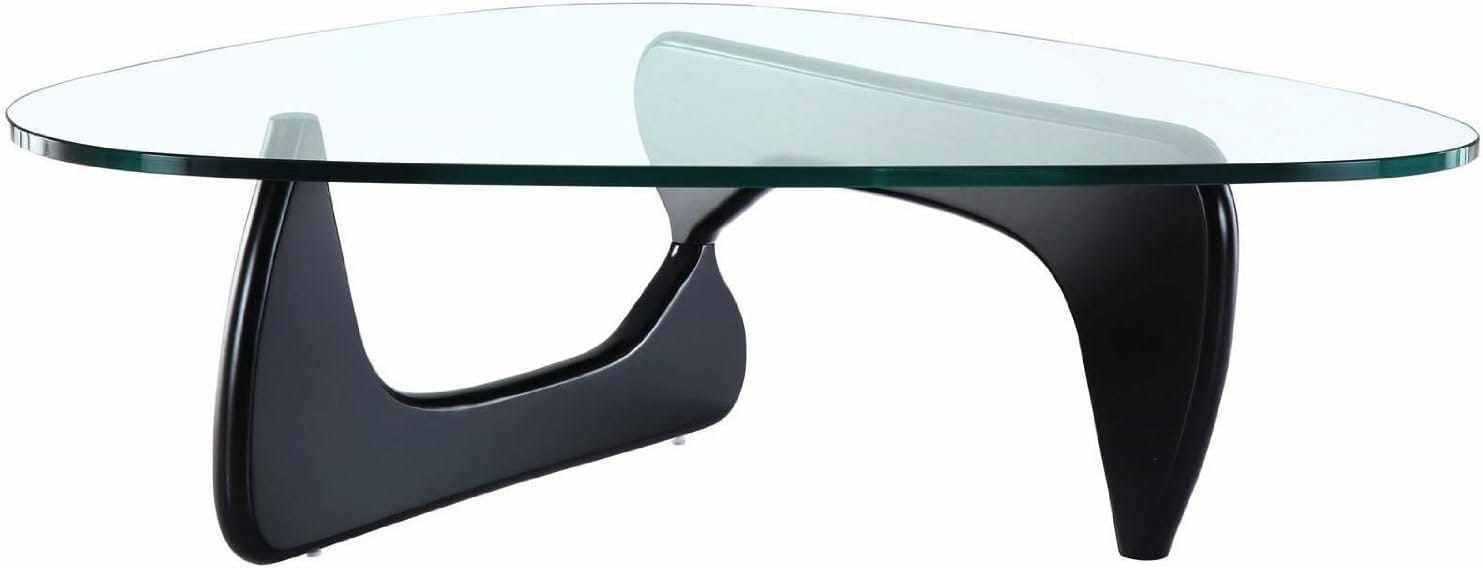
eMODERN FURNITURE — Mid-Century Modern Style Coffee Table, Black Hardwood Base
Price tier: Mid-Range
The eMod Black with hardwood base is the right pick for a contemporary room that needs the shape without a wood-tone statement. The black finish reads as furniture in a modern space rather than a museum-case object. Hardwood base confirmed.
Pros:
- Hardwood base confirmed
- Black finish integrates with contemporary interiors
- Established eMod production quality
Cons:
- Glass spec less clear in listings than competitor options
- Similar price to cherry option with fewer contextual advantages
Who it’s for: Contemporary interiors, office spaces, or rooms where the table needs to function as furniture rather than make a period reference.
Why it stands out: Among the eMod range, this is the version for rooms that aren’t doing a period exercise.
Quick Decision Guide
Best overall: HuPoFun Dark Walnut — correct proportions, solid hardwood, the only budget/mid-range reproduction available with 0.75-inch glass.
Best budget with correct specs: eChamp Black — solid wood base and 19mm glass at under $300. Meets both structural criteria.
Best for mid-century modern rooms: eMod Cherry — cherry bases existed only in 1947, the first production year. In a warm MCM room, this choice makes design-historical sense.
Best glass specification: HuPoFun 0.75-inch — this variant is the only reproduction found at the 0.75-inch (19mm) thickness that Herman Miller has used since 1965, when the original spec was adjusted down from 7/8-inch (22mm) glass.
If you want the original: Herman Miller sells the licensed table through their website and authorized dealers. As of 2025, it retails between $1,499 and $1,999 depending on finish. That price includes the license, the manufacturing spec, and the Noguchi Foundation relationship. Reproductions cannot offer those things. They can offer the shape.
Full Comparison
| Product | Base Material | Glass Thickness | Price Tier | Best For | Link |
|---|---|---|---|---|---|
| HuPoFun Dark Walnut (0.75-inch) | Solid hardwood | 0.75 in / 19mm | Mid-Range | Matching original spec | Buy |
| HuPoFun Dark Walnut (0.47-inch) | Solid hardwood | 0.47 in / 12mm | Mid-Range | Best overall value | Buy |
| eChamp Black | Solid wood | 3/4 in / 19mm | Budget | Spec accuracy on a budget | Buy |
| eMod Cherry | Hardwood | Verify listing | Mid-Range | MCM interiors, warm tones | Buy |
| eMod Black Hardwood | Hardwood | Verify listing | Mid-Range | Contemporary rooms, offices | Buy |
What makes the best Noguchi coffee table reproductions worth buying
Two things determine whether a Noguchi reproduction holds up: the base material and the glass thickness. Everything else, including finish quality, packaging, and shipping, is secondary. Get those two wrong and the table will look like what it is: a cheap copy. Get them right and most people in the room won’t know the difference.
Base material: solid wood vs. MDF
The original Noguchi base is carved from solid wood: walnut, birch, or cherry, depending on when it was made. The curves aren’t veneered or painted MDF. They’re solid.
MDF bases show their nature over time. Edges chip. Moisture causes swelling. The surface finish peels at stress points. A reproduction with an MDF base will be fine for a year or two in a dry climate with careful use. It will start showing its age before the Herman Miller original ever would.
The listings to avoid are the ones that say “wood” or “wooden base” without specifying solid vs. engineered. Solid hardwood will be called out as such. If a listing can’t tell you what the base is made of, assume MDF.
Glass thickness: 0.47 inches vs. 0.75 inches
The original Noguchi table used 7/8-inch (22mm) glass through 1965. Herman Miller reduced this to 3/4 inch (19mm) in 1965, at which point the base height was also raised slightly to compensate. That 3/4-inch spec has been the standard for sixty years.
Most reproductions use 0.47-inch (12mm) glass. This is cheaper, lighter, and easier to ship without breakage. It’s also noticeable when you put the two tables next to each other. The thin glass looks thin. The table top lacks the visual weight that makes the original’s geometry work.
Most reproductions use 0.47-inch glass. It’s cheaper, lighter, easier to ship. It’s also noticeable — the thin glass looks thin.
The HuPoFun 0.75-inch variant and the eChamp are the only reproductions in this guide that hit the original 19mm spec. If you’re comparing against the Herman Miller original, glass thickness is where most reproductions fall short first.
The 52-degree angle
The two base elements interlock at a specific angle: 52 degrees. Herman Miller added indexing pins to their production in the late 1980s to maintain this angle precisely. Reproductions without equivalent engineering will drift over time. The legs shift, the table rocks, and the geometry that makes the design work starts to read as approximate.
This isn’t visible from a product photo. It shows up in reviews, in the words “wobble” and “unstable.” When reading reviews, filter for this specifically.
What Noguchi actually built — and why reproductions exist at all
Noguchi designed the table in 1944, and Herman Miller put it into production in 1947. The table entered the reproduction market for two reasons: the patent lapsed, and Herman Miller charges $1,500 for it.
The table’s design economy is unusual. Three components: two curved wood legs that interlock at a specific angle, and a glass top that rests on them. No fasteners in the base join. The glass holds itself in place by gravity and the geometry of the base. This is a design that uses almost nothing to do what it needs to do, which is why the shape hasn’t needed revision in eighty years.
The reproduction market exists because the shape is in the public domain and the shape is the product. You can’t reproduce the Herman Miller licensing relationship, or the Isamu Noguchi Foundation certification, or the manufacturing specification that’s been held to since 1947. But you can reproduce the three parts. Every reproduction brand is doing that calculation.
What you’re buying when you buy a reproduction is the shape. What you’re not buying is the rest of it. Whether that trade is worth making depends entirely on how seriously you want the object with its full production history versus the appearance. Both are legitimate positions.
MoMA holds model IN-50, Noguchi’s 1944 original, in its permanent collection. That object is what every reproduction is referencing, however distantly.
Further Reading
Hayden Herrera’s Listening to Stone: The Art and Life of Isamu Noguchi (Farrar, Straus and Giroux, 2015) is the biography that covers the furniture design period in full context, including the T.H. Robsjohn-Gibbings dispute over the table’s design and the Herman Miller relationship. It’s the most complete account of how the table went from a small plastic model Noguchi made around 1939-40 to a production object that’s been in continuous manufacture since 1947. If you’re buying a reproduction because you find the design genuinely interesting, this is the book to read.
- Hayden Herrera, Listening to Stone: The Art and Life of Isamu Noguchi (Farrar, Straus and Giroux, 2015) — covers the furniture design period, the Herman Miller relationship, and the design authorship dispute in full
- Isamu Noguchi, A Sculptor’s World (Harper & Row, 1968) — Noguchi’s own account of his practice, written at the height of his furniture and landscape work
For the broader survey of postwar design objects, see the iconic furniture design hub. For related companion pieces, see guides to Saarinen Tulip Chair reproductions and best modern dining chairs.
Frequently Asked Questions
Are Noguchi coffee table reproductions legal to buy and own?
Yes. The Noguchi table design is no longer under patent protection, which means unlicensed reproductions are legal to manufacture and purchase in most countries. Buying or owning a reproduction is not a legal issue. What reproductions cannot legally do is use Herman Miller’s or Vitra’s trademarks, claim to be the licensed original, or misrepresent themselves as officially produced objects.
What is the difference between a Noguchi reproduction and the Herman Miller original?
The Herman Miller original is produced under license from the Isamu Noguchi Foundation, manufactured to the designer’s specifications, and sells for $1,499 to $1,999 as of 2025. Reproductions are unlicensed copies, produced without Foundation oversight, and sold for $150 to $600. The materials and manufacturing tolerances on the original are tighter. The shape is the same.
How thick should the glass be on a Noguchi table reproduction?
The original Herman Miller specification since 1965 is 3/4 inch (19mm). Many reproductions use 0.47-inch (12mm) glass, which is thinner and cheaper. If glass thickness matters to you, look specifically for listings that call out 0.75-inch or 19mm. The HuPoFun 0.75-inch variant and the eChamp both meet the original spec.
What wood is the Noguchi coffee table base made of?
The original Herman Miller table has been produced in walnut, birch (discontinued 1954), cherry (first year, 1947 only), ebonized walnut, and white ash. Current production offers walnut, white ash, ebonized walnut, and natural cherry. For reproductions, the most common finishes are walnut, black, and white. The base material should be solid hardwood. Listings that say ‘solid wood’ or ‘hardwood’ are preferable to those that say ‘wood’ without specifying.
Is the Vitra Noguchi table better than a reproduction?
Yes, in the same way the Herman Miller version is better. Vitra is the licensed manufacturer for Europe, operating under the same Foundation relationship as Herman Miller. The table is produced to the original specification. For buyers in Europe, Vitra is the equivalent of Herman Miller: an authorized version, not a reproduction.
How do I tell if a Noguchi table reproduction has a solid wood base?
Look for listings that say ‘solid hardwood,’ ‘solid ash,’ ‘solid walnut,’ or ‘solid cherry.’ ‘Engineered wood,’ ‘composite wood,’ or simply ‘wood base’ without qualification usually means MDF or particleboard. Reading the one-star reviews is useful. MDF bases fail at the edges over time, and reviewers document this specifically.

About Zoe Post
Zoe Post holds a BFA and a Master of Architecture from the School of the Art Institute of Chicago. She now works as a product marketing leader at an architectural product design firm, bringing hands-on industry perspective to everything she writes. At ADI she covers contemporary artists, textile and pattern design, and the design objects that sit at the boundary of art and function.